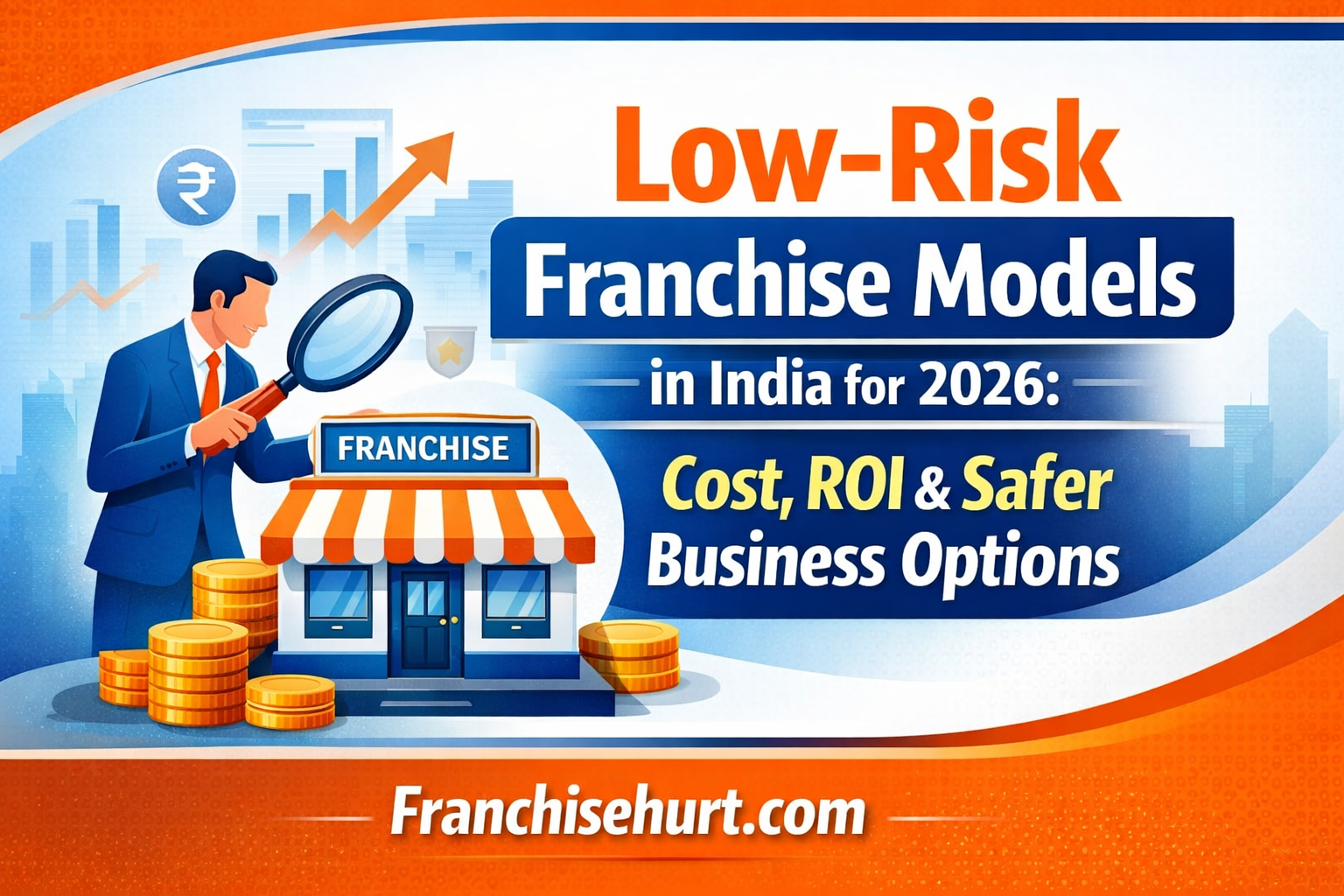
Low-Risk Franchise Models in India for 2026: Cost, ROI & Safer Business Options

Low-Risk Franchise Models in India (2026 Overview)
| Franchise Category | Investment Range | Break-Even Period | Risk Level | Best For |
|---|---|---|---|---|
| Home Services | ₹3–10 Lakhs | 6–12 Months | Low | First-time investors |
| Education & Skills | ₹5–15 Lakhs | 10–18 Months | Low | Long-term stability |
| Logistics & Delivery | ₹4–12 Lakhs | 8–14 Months | Low–Moderate | Tier-2 & Tier-3 cities |
| Pet Care Services | ₹6–18 Lakhs | 12–20 Months | Moderate | Urban markets |
| Car Care & Detailing | ₹7–20 Lakhs | 12–18 Months | Moderate | Auto-focused entrepreneurs |
| Healthcare Support | ₹8–25 Lakhs | 12–24 Months | Low | Trust-driven businesses |
Table of Contents
Introduction
Investing in a franchise in India has changed significantly over the past few years. By 2026, Indian investors are no longer chasing flashy brand names or unrealistic profit promises. Instead, they are focusing on low-risk franchise models that offer stable demand, controlled investment, and transparent operations.
Rising commercial rents, oversaturated food franchises, and increased awareness of franchise scams have made caution essential. As a result, service-based, asset-light, and demand-backed franchises are emerging as the preferred choice for first-time entrepreneurs and conservative investors alike.
In this guide, we break down low-risk franchise models Indians are choosing in 2026, explain why these businesses are considered safer, outline realistic investment and break-even expectations, and help you evaluate which model suits your goals—without hype or false guarantees.
Understanding “Low-Risk Franchise” in the Indian Context
A common misconception is that a low-risk franchise guarantees profits. In reality, no legitimate business can guarantee returns. A low-risk franchise instead focuses on risk control and predictability.
In 2026, a franchise is considered low-risk if it demonstrates:
- Consistent and essential market demand
- Reasonable entry cost relative to earning potential
- Simple and standardised operations
- Limited dependence on highly skilled labour
- Clear franchise agreements with exit visibility
- Faster break-even compared to traditional businesses
Low-risk does not mean low effort—it means lower exposure to sudden losses.
Why Indians Are Actively Choosing Low-Risk Franchise Models in 2026
Several economic and behavioural factors are influencing this trend:
1. Increased Awareness of Franchise Scams
With more investors sharing negative experiences online, buyers are now cautious about brands making unrealistic income claims.
2. Rising Cost of Commercial Real Estate
High rentals have made large-format franchises risky, pushing investors toward compact and service-based models.
3. Saturation of Food & Beverage Franchises
Many food franchises face intense competition, high wastage, and dependency on daily footfall.
4. Shift Towards Service & Subscription Businesses
Services offer repeat customers, predictable cash flow, and lower inventory risk.
5. Preference for Scalable & Flexible Operations
Investors want businesses that can expand gradually or be managed semi-passively.
Research Insights: Why Indians Prefer Low-Risk Franchise Models in 2026
- Service-based franchises are growing faster than product-heavy models
Businesses offering essential services (home services, logistics, healthcare support) show more stable demand and lower failure rates. (Source: IBEF – Indian Services Sector) - Faster break-even has become a key investment decision factor
Investor preference has shifted toward franchise models with 6–18 months break-even due to capital protection concerns. (Source: Franchise India Industry Reports) - Tier-2 & Tier-3 cities are driving safer franchise expansion
Lower rentals, reduced competition, and rising disposable income make non-metro cities ideal for low-risk franchises. (Source: DPIIT & Ministry of Commerce) - Asset-light business models outperform asset-heavy formats
Franchises with low inventory and minimal infrastructure show better resilience during economic slowdowns. (Source: RedSeer Strategy Consultants) - Recurring revenue models reduce business volatility
Subscription and repeat-service models (AMCs, education renewals, logistics contracts) offer predictable cash flow. (Source: PwC India – Consumer & SME Insights) - Increased awareness of franchise scams has changed investor behaviour
Investors now prioritise agreement transparency, existing franchisee feedback, and realistic unit economics. (Source: Ministry of Consumer Affairs (India))
Top Low-Risk Franchise Models Indians Are Choosing in 2026
1. Home & Essential Service Franchises
These franchises focus on non-discretionary services required by households, offices, and commercial properties.
Popular segments include:
- Home cleaning & sanitation
- Pest control services
- Electrical, plumbing, and appliance repair
- Facility management solutions
Why this model works:
- Demand remains stable regardless of economic cycles
- Services can be sold via contracts or subscriptions
- Minimal inventory and infrastructure requirements
Investment Range: ₹3–10 lakhs
Break-Even Period: 6–12 months
2. Education & Skill-Based Franchises (Beyond Traditional Coaching)
Rather than crowded tuition centres, investors are choosing education models aligned with future skills.
Examples include:
- Preschool & early learning centres
- Coding, robotics, and STEM programs
- Skill development and vocational training
- Language and test-support services
Why this model works:
- Education spending remains a top priority for Indian families
- Repeat enrolments ensure recurring revenue
- Government and corporate skill initiatives support long-term demand
Investment Range: ₹5–15 lakhs
Break-Even Period: 10–18 months
3. Logistics & Last-Mile Delivery Franchises
India’s logistics ecosystem continues to grow alongside e-commerce, quick commerce, and hyperlocal delivery.
Includes:
- Courier and parcel delivery franchises
- Micro-warehousing and fulfilment centres
- Hyperlocal delivery hubs
Why this model works:
- Driven by long-term consumption and online shopping habits
- Business comes through corporate contracts, not walk-in customers
- Location flexibility across Tier-2 and Tier-3 cities
Investment Range: ₹4–12 lakhs
Break-Even Period: 8–14 months
4. Pet Care & Pet Retail Franchises
India’s pet ownership has grown significantly, especially in urban and semi-urban areas.
Popular formats include:
- Pet grooming studios
- Pet retail and essential supplies
- Veterinary support services
Why this model works:
- Pet care spending is emotionally driven and consistent
- High customer loyalty and repeat purchases
- Opportunities for cross-selling products and services
Investment Range: ₹6–18 lakhs
Break-Even Period: 12–20 months
5. Car Care & Auto Detailing Franchises
Instead of full-scale garages, specialised car care franchises are becoming popular among investors.
Services typically include:
- Car detailing & polishing
- Ceramic coating
- Interior cleaning and protection
Why this model works:
- Growing vehicle ownership across India
- Repeat servicing from existing customers
- Compact setup and modular expansion options
Investment Range: ₹7–20 lakhs
Break-Even Period: 12–18 months
6. Healthcare Support & Diagnostic Collection Franchises
These franchises operate without the need for doctors or advanced medical infrastructure.
Includes:
- Diagnostic sample collection centres
- Medical equipment rental services
- Home healthcare support operations
Why this model works:
- Healthcare demand is non-cyclical
- Strong trust and brand credibility
- Often supported by established healthcare networks
Investment Range: ₹8–25 lakhs
Break-Even Period: 12–24 months
How to Professionally Evaluate a Low-Risk Franchise Before Investing
Before paying any franchise fee, investors should conduct structured due diligence:
- Review the franchise agreement for exit clauses and penalties
- Understand the exact support provided after onboarding
- Verify unit-level profitability instead of brand-level claims
- Speak directly with existing franchise partners
- Check legal history, complaints, and brand reputation
A franchise becomes low-risk only when information is transparent and verifiable.
Common Mistakes That Increase Franchise Risk
Many investors unintentionally increase risk by:
- Choosing brands based only on social media marketing
- Trusting verbal income assurances
- Underestimating working capital requirements
- Ignoring local market demand
- Skipping professional agreement review
Avoiding these mistakes can significantly improve success probability.
Final Verdict: Are Low-Risk Franchise Models Worth It in 2026?
Low-risk franchise models are not shortcuts to instant wealth. Instead, they offer stability, controlled exposure, and long-term growth potential. In 2026, Indian investors who prioritise service-based, demand-backed, and asset-light franchises are far more likely to succeed than those chasing hype-driven brands.
If your goal is predictable income, scalable operations, and protection from common franchise pitfalls, low-risk franchise models represent the most practical path forward.
Frequently Asked Questions(FAQs)
1. What is the safest franchise business to start in India in 2026?
Ans: There is no single “safest” franchise, but service-based franchises such as home services, logistics, education support, healthcare assistance, and car care are considered safer due to steady demand, lower inventory risk, and predictable operating costs.
2. Are low-risk franchises suitable for first-time entrepreneurs?
Ans: Yes. Low-risk franchises are particularly suitable for first-time investors because they offer structured operations, training support, and proven business frameworks, reducing the chances of costly mistakes.
3. How much investment is required for a low-risk franchise in India?
Ans: Most low-risk franchise models in India require an investment between ₹3 lakhs and ₹15 lakhs. Some healthcare and specialised service franchises may require higher capital depending on infrastructure and brand strength.
4. Can low-risk franchises be managed part-time?
Ans: Certain service-based and logistics franchises can be managed semi-passively once systems and staff are in place. However, active involvement is recommended during the initial 6–12 months.
5. Do low-risk franchises guarantee profits?
Ans: No genuine franchise guarantees profits. Low-risk franchises only reduce exposure to losses by offering stable demand, transparent costs, and scalable models. Success still depends on execution and local market conditions.
6. How long does it take to break even in a low-risk franchise?
Ans: Break-even periods typically range from 6 months to 24 months, depending on the franchise category, location, operating efficiency, and local demand.
7. How can I avoid franchise scams while investing?
Ans: Always verify brand credentials, read the franchise agreement carefully, speak to existing franchise partners, av