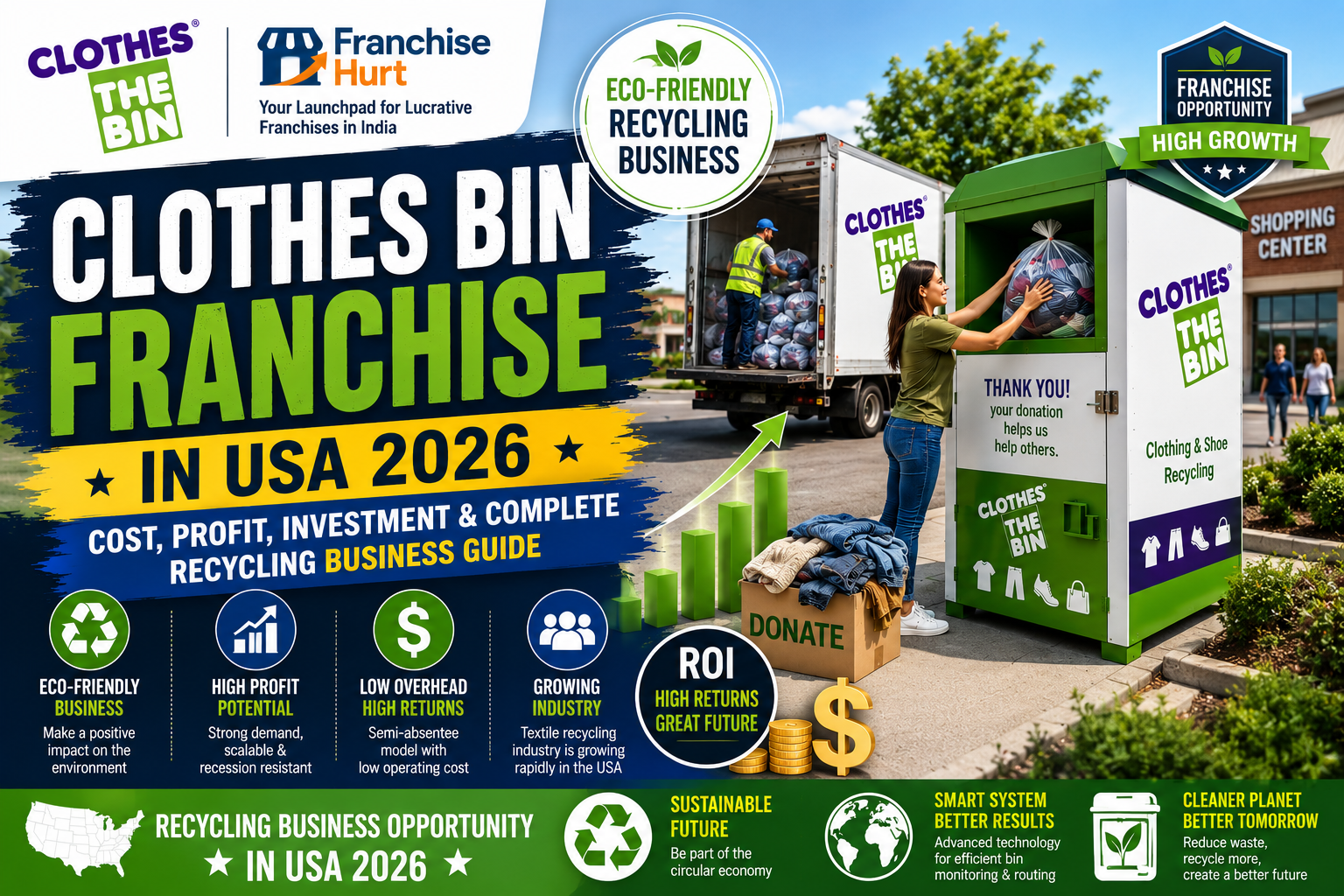
Clothes Bin Franchise in USA 2026: Cost, Profit, Investment & Complete Recycling Business Guide
The recycling and sustainability industry in the United States continues growing rapidly as consumers, businesses, schools, and communities become more environmentally conscious. One of the fastest-growing segments within the green business industry is textile recycling, where unwanted clothes, shoes, and fabrics are collected and repurposed instead of ending up in landfills.
Among the emerging eco-friendly franchise opportunities in the USA, Clothes Bin Franchise has built a unique business model focused on clothing and textile recycling through strategically placed collection bins powered by smart technology.
For entrepreneurs looking for a semi-absentee, home-based, and scalable business opportunity, the Clothes Bin Franchise offers a modern recycling business model with relatively low operational complexity and growing environmental demand.
This guide explains Clothes Bin franchise cost, investment, founder details, royalty fees, business model, profit potential, support, requirements, and how to start a Clothes Bin recycling franchise in the USA in 2026.
Quick Overview of Clothes Bin Franchise
| Particulars | Details |
|---|---|
| Brand Name | Clothes Bin |
| Industry | Recycling & Environmental Services |
| Business Type | Textile Recycling Franchise |
| Headquarters | Fort Lauderdale, Florida |
| Founded | 2014 |
| Franchising Since | 2015 |
| Investment Range | $160,000 – $220,000 |
| Franchise Fee | Starting Around $49,500 |
| Royalty Fee | Approx. $6 Per Bin/Week |
| Business Model | Semi-Absentee |
| Ownership Type | Home-Based Franchise |
| Demand Level | Growing Rapidly |
Table of Contents
About Clothes Bin Franchise
Clothes Bin Franchise Official Website is one of the first textile recycling franchise systems in the United States focused entirely on clothing, shoe, and textile collection through branded recycling bins.
The company places strategically located recycling bins at:
- Shopping centers
- Schools
- Gas stations
- Community centers
- Convenience stores
- Apartment complexes
The collected materials are later sold or distributed through textile recycling and reuse channels.
The franchise model combines:
- Sustainability
- Recycling services
- Smart technology
- Semi-absentee ownership
- Scalable territory operations
This makes Clothes Bin different from traditional retail or restaurant franchises.
Founder Details & Leadership Team
Clothes Bin Franchise established its national textile recycling business model in 2014 with the goal of building one of the first large-scale clothing and textile recycling franchise systems in the United States.
The company focuses on eco-friendly textile collection, sustainability initiatives, and smart recycling operations through strategically placed clothing donation bins across multiple U.S. markets.
Founders & Leadership Team
| Leadership Role | Name |
|---|---|
| Co-Founder & COO | Nick Boariu |
| Co-Founder | Danny J. Portuondo |
| Chief Executive Officer (CEO) | Bruce Buttles |
| President | Marc Douglas |
According to Clothes Bin Franchise Official Website, the company continues focusing on technology-driven recycling operations, territory expansion, and scalable franchise growth across the United States.
Brand Growth & Expansion
The company expanded rapidly by combining:
- Textile recycling services
- Sustainability-focused business operations
- Smart monitoring technology
- Semi-absentee franchise systems
- Community-based recycling partnerships
In July 2021, Clothes Bin Franchise was acquired by investment firm Greybull Stewardship to support the company’s national expansion strategy and long-term growth within the recycling and environmental services industry.
This expansion helped strengthen the brand’s position in:
- Eco-friendly business franchising
- Textile recycling operations
- Sustainability-focused franchise opportunities
- Circular economy business models
Today, Clothes Bin continues expanding its franchise network while promoting environmentally responsible textile recycling solutions across the United States. one of the first dedicated textile recycling franchise systems in the United States.
Also Read: Blue Coast Burrito Franchise
Leadership
Robert Speck serves as President and Chief Executive Officer and has played a key role in the company’s operational growth and franchise expansion.
The company also gained recognition through:
- Entrepreneur Franchise 500
- Top New Franchise mentions
- Green business franchise rankings
- Sustainability-focused business publications
Why Choose Clothes Bin Franchise?
1. Growing Recycling Industry
Environmental awareness and sustainability initiatives continue increasing across the United States.
2. Semi-Absentee Business Model
The business can often be managed part-time using route planning and monitoring systems.
3. Home-Based Operations
Many franchisees can operate without maintaining a traditional office or storefront.
4. Technology-Powered System
The franchise uses BLIP® technology to monitor bin capacity and optimize collection routes.
5. Scalable Business Opportunity
Franchise owners can expand by adding additional bins and territories.
Americans Discard Billions of Pounds of Textiles Every Year
According to industry reports, most unwanted clothes and textiles still end up in landfills, creating massive recycling opportunities for textile collection businesses. (Franchise Gator)
Research Insights & Industry Data
The textile recycling and sustainability industry continues expanding due to increasing environmental awareness and waste reduction efforts.
According to EPA Sustainable Materials Management, millions of tons of textiles are discarded in the United States every year, while a large percentage remains recyclable or reusable.
The rise of sustainability-focused consumers and businesses is also driving growth in:
- Recycling services
- Circular economy businesses
- Waste reduction solutions
- Eco-friendly franchise models
According to (FBA), Clothes Bin positions itself as a technology-driven textile recycling franchise operating within the growing circular economy sector.
Related Reads: Acai Express Franchise
Key Industry Trends
| Industry Trend | Business Impact |
|---|---|
| Sustainability Awareness | Higher Recycling Participation |
| Textile Waste Growth | Increased Collection Opportunities |
| Circular Economy Expansion | More Recycling Demand |
| Eco-Friendly Consumer Behavior | Strong Long-Term Potential |
How the Clothes Bin Business Works
Step 1: Place Bins
Franchisees place branded recycling bins in approved high-traffic locations.
Step 2: Collect Textiles
Consumers drop unwanted clothes, shoes, and textiles into the bins.
Step 3: Monitor Bins with BLIP® Technology
The company’s technology system tracks bin capacity and collection needs.
Step 4: Service Full Bins
Franchisees collect and transport materials when bins approach capacity.
Step 5: Sell Collected Textiles
Collected materials can be distributed through approved recycling and textile buyers.
Clothes Bin Franchise Cost & Investment
The investment required depends on:
- Territory size
- Number of bins
- Equipment requirements
- Transportation setup
- Working capital needs
Estimated Investment Breakdown
| Expense Category | Estimated Cost |
|---|---|
| Franchise Fee | $49,500 |
| Initial Bin Package | $40,000 – $80,000 |
| Vehicle & Transportation | $20,000 – $50,000 |
| Technology Systems | Included |
| Insurance & Licensing | $5,000 – $15,000 |
| Working Capital | $20,000 – $40,000 |
| Miscellaneous Expenses | $10,000 – $20,000 |
| Total Investment | $160,000 – $220,000 |
Investment estimates may vary depending on territory size and operational scale. (Franchise Gator)
Franchise Royalty & Fees
| Fee Type | Estimated Details |
|---|---|
| Franchise Fee | Starting around $49,500 |
| Royalty Fee | Approx. $6 Per Bin/Week |
| Marketing Fee | May vary |
| Technology Support | Included in operations |
The flat-rate royalty model makes budgeting relatively predictable compared to percentage-based royalty systems.
Profit Margin & ROI
Estimated Revenue Potential
| Scale of Operations | Potential Earnings |
|---|---|
| Small Territory | Moderate |
| Medium Territory | Growing Revenue |
| Large Territory | Higher Scalability |
Financial Overview
| Metric | Details |
|---|---|
| Business Model | Semi-Absentee |
| Operational Complexity | Moderate |
| Scalability | Excellent |
| Long-Term Demand | Growing |
Profitability depends on:
- Number of active bins
- Bin placement quality
- Operational efficiency
- Collection routes
- Textile buyer relationships
Why Clothes Bin Stands Out
1. First Textile Recycling Franchise
One of the first franchise systems dedicated entirely to textile recycling.
2. No Traditional Inventory
Franchisees do not operate with traditional retail inventory models.
3. Flexible Operations
Many owners continue working other jobs while operating the franchise.
4. Community Impact
The business helps reduce landfill waste and supports sustainability goals.
5. Smart Technology Integration
BLIP® technology improves operational efficiency and route optimization.
Clothes Bin Uses Smart Monitoring Technology
The BLIP® (Bin Location Information Program) system helps franchisees monitor bins remotely and optimize collection routes.
Franchise Support Provided
Franchise owners generally receive support in:
- Initial training
- Bin placement guidance
- Territory mapping
- Route optimization
- Technology dashboard training
- Ongoing operational support
- Marketing guidance
According to franchise sources, franchisees also receive onboarding and operational support during launch phases. (IFPG)
Best Locations for Clothes Bin Franchise
| Location Type | Opportunity Level |
|---|---|
| Shopping Centers | Very High |
| Schools & Colleges | High |
| Gas Stations | High |
| Apartment Communities | High |
| Convenience Stores | Excellent |
| Community Centers | Growing |
High-traffic public areas generally perform best for recycling collection bins.
Eligibility Criteria
Applicants generally should have:
- Business management interest
- Operational discipline
- Territory management capability
- Vehicle access
- Required investment capital
Prior recycling experience is generally not mandatory, though operational and business experience may help.
Required Documents
| Document | Purpose |
|---|---|
| Business Registration | Legal Operations |
| Tax Documentation | Financial Compliance |
| Insurance Documents | Risk Management |
| Vehicle Registration | Transportation Operations |
| Franchise Agreement | Business Authorization |
How to Apply for Clothes Bin Franchise
Step 1: Visit Official Website
Clothes Bin Franchise Information
Step 2: Submit Franchise Inquiry
Provide territory and investment information.
Step 3: Franchise Evaluation
The company reviews financial and operational suitability.
Step 4: Discovery Process
Applicants review franchise documents and business details.
Step 5: Training & Territory Setup
Technology systems and initial bin operations are established.
Step 6: Launch Operations
The franchise begins collection and recycling operations.
Challenges in Recycling Franchise Business
Common Challenges
- Finding high-performing locations
- Route management
- Transportation logistics
- Competition for collection sites
- Operational scaling
Efficient territory management and consistent servicing are essential for long-term success.
Future Outlook of Textile Recycling Industry
The future of textile recycling businesses in the USA remains highly promising because of:
- Rising environmental awareness
- Sustainability-focused consumers
- Growth in recycling programs
- Circular economy expansion
- Increasing landfill reduction efforts
Eco-friendly franchises and recycling businesses are expected to continue growing across the United States.
Conclusion
The Clothes Bin Franchise represents a growing eco-friendly business opportunity within the expanding recycling and sustainability industry in the United States. With increasing environmental awareness, smart technology integration, and scalable territory operations, the franchise offers a unique alternative to traditional retail or restaurant franchises.
For entrepreneurs interested in green business opportunities, semi-absentee ownership, and sustainability-focused operations, Clothes Bin can offer a promising business model in 2026 and beyond.
Frequently Asked Questions (FAQs)
1. How much does a Clothes Bin franchise cost?
Ans: The estimated investment generally ranges between $160,000 and $220,000.
2. Is Clothes Bin a home-based franchise?
Ans: Yes, many franchisees operate the business from home-based setups.
3. What is the royalty fee for Clothes Bin?
Ans: The estimated royalty fee is approximately $6 per bin per week.
4. Is Clothes Bin a semi-absentee franchise?
Ans: Yes, the franchise is commonly promoted as a semi-absentee business model.
5. What does Clothes Bin collect?
Ans: The bins generally collect clothes, shoes, textiles, and other reusable fabrics.