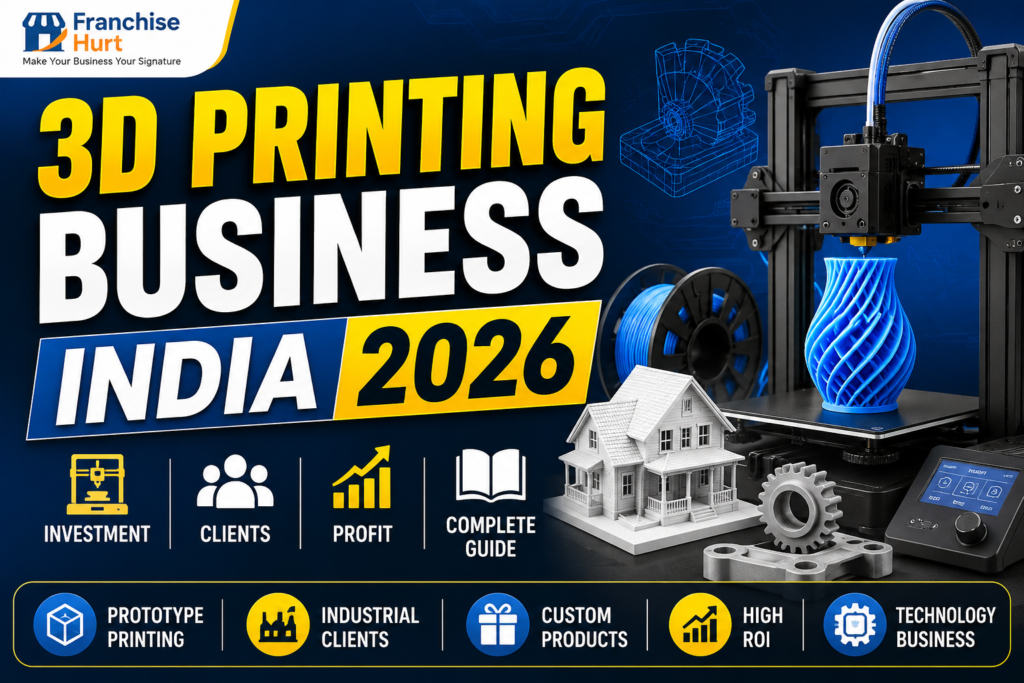
3D Printing Business India 2026: Investment, Clients & Profit — Complete Guide
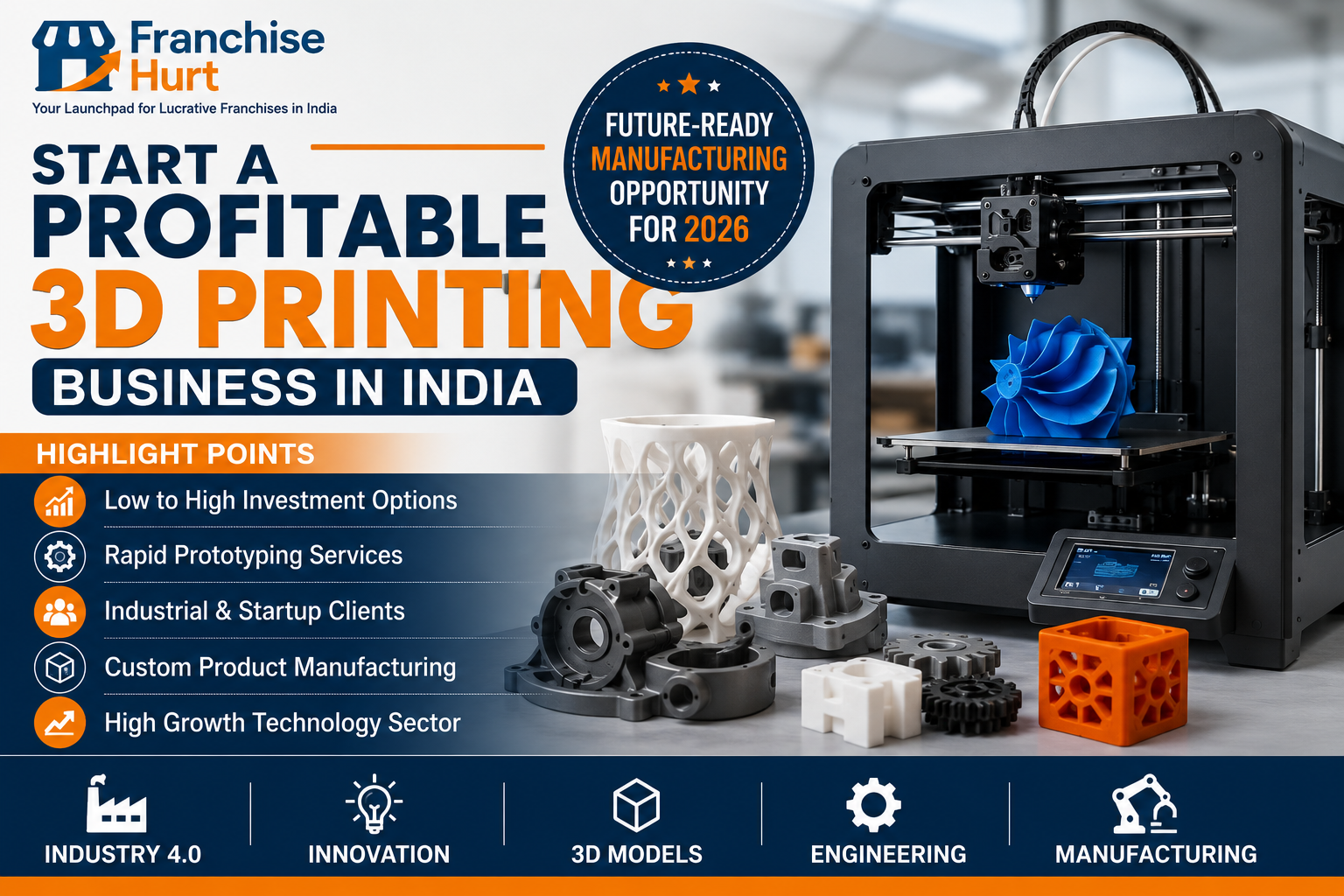
The 3D printing industry in India continues growing rapidly because of increasing demand for customized manufacturing, rapid prototyping, product design, and industrial automation. Businesses across sectors like healthcare, automotive, education, construction, fashion, engineering, and product manufacturing are increasingly using 3D printing technology for faster production and lower development costs.
For entrepreneurs and technology enthusiasts, starting a 3D printing business in India in 2026 can become a profitable opportunity because of rising industrial demand, affordable desktop 3D printers, and growing adoption of additive manufacturing technologies.
This complete guide explains everything about the 3D printing business in India, including investment, machines, clients, profit margins, products, business models, operational costs, and future growth opportunities.
What Is a 3D Printing Business?
A 3D printing business involves creating physical objects layer-by-layer using digital design files and specialized printing machines. The process is also known as additive manufacturing.
Entrepreneurs can offer:
- Prototype printing
- Product model development
- Industrial component manufacturing
- Customized products
- Educational models
- Architectural designs
- Medical models
- Personalized gifts
Businesses usually charge clients based on:
- Material usage
- Printing time
- Design complexity
- Product size
Why 3D Printing Businesses Are Growing in India
India’s manufacturing and startup ecosystem continues adopting modern technologies to improve efficiency and reduce product development time.
Several major factors continue supporting the growth of 3D printing businesses:
- Rising startup ecosystem
- Increasing demand for rapid prototyping
- Growth of customized manufacturing
- Expansion of engineering and product design industries
- Adoption in healthcare and education sectors
- Lower production cost for small-batch manufacturing
- Growing awareness of Industry 4.0 technologies
Government initiatives supporting manufacturing and innovation also continue helping advanced technology businesses grow in India.
Quick Business Overview
| Particulars | Details |
|---|---|
| Business Type | Technology & Manufacturing |
| Investment Range | ₹1 Lakh – ₹25 Lakhs |
| Profit Margin | 20%–60% |
| ROI Timeline | 1–3 Years |
| Skill Requirement | Moderate to High |
| Demand | Growing Rapidly |
| Scalability | Excellent |
Table of Contents
Types of 3D Printing Business Models
Entrepreneurs can choose different business models depending on investment capacity and target clients.
Prototype Printing Services
This is one of the most common business models where startups and manufacturers require sample product prototypes before mass production.
Clients
- Startups
- Product designers
- Engineering firms
- Manufacturing companies
Profit Potential
High because customized prototype work usually has strong margins.
Customized Product Printing
Businesses can create personalized products for consumers.
Popular Products
- Customized gifts
- Phone stands
- Miniatures
- Home décor items
- Fashion accessories
- Nameplates
Best Sales Platforms
- Amazon
- Etsy
- Flipkart
Industrial Component Manufacturing
Some businesses manufacture machine parts and industrial components using advanced 3D printing systems.
Industries Served
- Automotive
- Aerospace
- Machinery manufacturing
- Engineering
This model generally requires higher investment but offers better revenue potential.
Educational 3D Printing Services
Schools, colleges, and training institutes increasingly require educational models and demonstrations.
Educational Products
- Science models
- Engineering components
- Robotics parts
- Architectural designs
Medical & Dental 3D Printing
Healthcare sectors increasingly use 3D printing for customized solutions.
Medical Applications
- Dental aligners
- Surgical models
- Prosthetics
- Orthopedic models
This sector continues seeing strong future growth potential in India.
Investment Required for 3D Printing Business
Investment mainly depends on printer quality, production scale, and target market.
Estimated Investment Breakdown
| Expense Category | Estimated Cost |
|---|---|
| Entry-level 3D printer | ₹20,000 – ₹1 Lakh |
| Industrial-grade printers | ₹5 Lakhs – ₹20 Lakhs |
| Computer systems | ₹50,000 – ₹2 Lakhs |
| Design software | ₹20,000 – ₹1 Lakh |
| Raw materials | ₹20,000 – ₹1 Lakh |
| Workspace setup | ₹50,000 – ₹3 Lakhs |
Small businesses can initially start with affordable desktop 3D printers and gradually expand operations.
Workspace Requirements
Small 3D printing businesses can initially start from home or small office spaces.
Recommended Setup
- Ventilated workspace
- Stable electricity connection
- Computer workstation
- Printer storage area
- Raw material storage
Industrial-scale operations may require larger production facilities with multiple machines and dedicated production areas.
Types of 3D Printers Used in Business
Different industries require different printing technologies.
FDM Printers
Most affordable and commonly used for beginner businesses.
Best For
- Prototypes
- Educational models
- Consumer products
Resin Printers
Used for high-detail printing applications.
Best For
- Jewelry
- Dental products
- Miniatures
- Detailed product models
Industrial 3D Printers
Advanced machines used for industrial-grade manufacturing.
Best For
- Automotive parts
- Engineering components
- Aerospace applications
Raw Materials Used in 3D Printing
The business requires specialized materials depending on the printer type.
Common Materials
- PLA filament
- ABS plastic
- Resin
- Nylon
- PETG
- Carbon fiber composites
Material quality directly affects final product quality and customer satisfaction.
Best-Selling 3D Printed Products in India
Some 3D printed products continue seeing strong demand in Indian markets.
High-Demand Products
- Customized keychains
- Action figures
- Home décor items
- Engineering prototypes
- Architectural models
- Mobile stands
- Dental models
- Jewelry molds
- Machine spare parts
- Educational science models
Customized and niche products often provide higher profit margins.
Clients for 3D Printing Businesses
Finding the right client base is important for profitability and long-term growth.
Startups
Startups require prototypes and product development support.
Engineering Companies
Engineering firms increasingly use 3D printing for testing and design.
Architects
Architectural firms require building models and layout designs.
Schools & Colleges
Educational institutions use 3D printed models for demonstrations.
Hospitals & Dental Clinics
Medical sectors increasingly adopt customized healthcare applications.
Product Designers
Designers frequently require sample models and concept products.
Skills Required for 3D Printing Business
Entrepreneurs should understand both technical and business aspects.
Important Skills
- 3D modeling
- CAD software
- Printer maintenance
- Material selection
- Product design
- Customer handling
Learning software like Blender, Fusion 360, SolidWorks, or AutoCAD can improve business opportunities.
Team Requirements
Small businesses can initially operate with:
- One designer
- One printer operator
- One marketing person
Larger businesses may require:
- CAD engineers
- Machine technicians
- Sales executives
- Production supervisors
Building a skilled technical team can help improve production quality and client satisfaction.
Business Registration & Licenses Required
Depending on the business scale, entrepreneurs may require:
- GST registration
- MSME/Udyam registration
- Shop & Establishment license
- Business bank account
- Trade license
- Import license for imported machines
Small home-based businesses may initially operate with fewer compliance requirements, but proper registration helps build credibility and attract industrial clients.
Monthly Operational Costs
Running costs generally include electricity, materials, labor, maintenance, and marketing expenses.
Approximate Monthly Expenses
| Expense Type | Approx Monthly Cost |
|---|---|
| Electricity | ₹3,000 – ₹20,000 |
| Materials | ₹10,000 – ₹1 Lakh |
| Maintenance | ₹2,000 – ₹15,000 |
| Employee salaries | ₹15,000 – ₹1 Lakh |
| Marketing | ₹5,000 – ₹50,000 |
Operational expenses vary depending on production volume and business scale.
Profit Margin & Earnings Potential
3D printing businesses generally offer high profit margins because customized manufacturing often carries premium pricing.
Approximate Profit Margins
| Business Type | Margin Range |
|---|---|
| Prototype printing | 30%–60% |
| Customized products | 40%–70% |
| Industrial manufacturing | 20%–50% |
| Educational models | 30%–55% |
Experienced businesses with strong client networks can generate significant monthly revenue.
Platforms to Sell 3D Printed Products
Entrepreneurs can sell products through multiple online and offline platforms.
Popular Selling Platforms
- Amazon
- Flipkart
- Etsy
- IndiaMART
- Shopify websites
- Facebook Marketplace
Online marketplaces help businesses reach larger customer bases across India and international markets.
How to Get Clients for 3D Printing Business
Client acquisition plays a major role in business growth.
Build Instagram Portfolio
Showcase printed models and designs through reels and product videos.
Create Professional Website
A business website improves credibility and lead generation.
Join B2B Platforms
Platforms like IndiaMART and TradeIndia help attract industrial clients.
Network with Startups
Startup incubators and engineering communities often require prototyping services.
Use LinkedIn Marketing
LinkedIn works well for industrial and B2B client acquisition.
Challenges in 3D Printing Business
Entrepreneurs should also understand the operational challenges.
High Initial Learning Curve
Technical knowledge is important for quality production.
Machine Maintenance
Printers require regular calibration and maintenance.
Material Costs
High-quality materials may increase operational expenses.
Competition
Growing market competition may affect pricing.
Slow Production Speed
Large products may take several hours or days to print.
Advantages of Starting a 3D Printing Business
High Future Growth Potential
The additive manufacturing industry continues expanding globally.
Scalable Business Model
Businesses can gradually expand into industrial manufacturing.
Multiple Industry Applications
3D printing serves many industries simultaneously.
Low Inventory Requirement
Most products are manufactured on-demand.
Innovation-Driven Industry
Technology-focused businesses often attract premium clients.
Best Cities for 3D Printing Business in India
Some cities offer stronger industrial and startup ecosystems.
High-Potential Cities
- Bengaluru
- Hyderabad
- Pune
- Chennai
- Mumbai
- Delhi NCR
- Ahmedabad
These cities continue seeing strong demand from startups, engineering firms, and manufacturing companies.
Why 3D Printing Has Strong Future Potential
3D printing continues becoming an important part of Industry 4.0 and modern manufacturing systems. Businesses increasingly prefer rapid prototyping, customized production, and low-volume manufacturing solutions.
As technology becomes more affordable, adoption is expected to increase across:
- Healthcare
- Aerospace
- Automotive
- Education
- Consumer products
- Construction
This creates long-term growth opportunities for entrepreneurs entering the industry early.
Future Scope of 3D Printing Business in India
The future of 3D printing in India continues looking highly promising because of increasing industrial automation, startup innovation, and digital manufacturing adoption.
Industries such as:
- Healthcare
- Construction
- Aerospace
- Automotive
- Education
- Consumer electronics
continue adopting additive manufacturing technologies rapidly.
As printer costs continue decreasing and awareness increases, small businesses and startups are expected to adopt 3D printing more widely in the coming years.
Conclusion
The 3D printing business in India continues emerging as one of the most innovative and future-ready business opportunities in 2026. With applications across multiple industries, growing demand for customized manufacturing, and increasing startup activity, this sector offers strong long-term growth potential.
Entrepreneurs who invest in quality equipment, technical skills, strong client relationships, and efficient production systems can build profitable and scalable businesses in the growing additive manufacturing industry.
For technology-focused entrepreneurs looking for future-oriented businesses, 3D printing continues offering exciting opportunities with high innovation, scalability, and revenue potential.
Frequently Asked Questions (FAQs)
1. Is 3D printing business profitable in India?
Ans: Yes, 3D printing businesses can be highly profitable because of growing demand for prototypes, customized products, and industrial applications.
2. How much investment is required for a 3D printing business?
Ans: Investment may start from ₹1 lakh for small setups and go beyond ₹25 lakhs for industrial-scale businesses.
3. Which industries use 3D printing the most?
Ans: Healthcare, automotive, education, engineering, architecture, and product design industries widely use 3D printing.
4. Can beginners start a 3D printing business?
Ans: Yes, beginners can start with affordable desktop printers and gradually improve technical skills and client networks.
5. Which software is used in 3D printing business?
Ans: Popular software includes Blender, Fusion 360, SolidWorks, AutoCAD, and Cura.
6. Does 3D printing have future scope in India?
Ans: Yes, the industry continues growing rapidly because of increasing adoption of advanced manufacturing technologies across industries.
7. Can 3D printed products be sold online?
Ans: Yes, entrepreneurs can sell products through Amazon, Etsy, Instagram, Flipkart, and other e-commerce platforms.
8. Which 3D printer is best for beginners?
Ans: FDM printers are generally considered best for beginners because of affordability and ease of use.