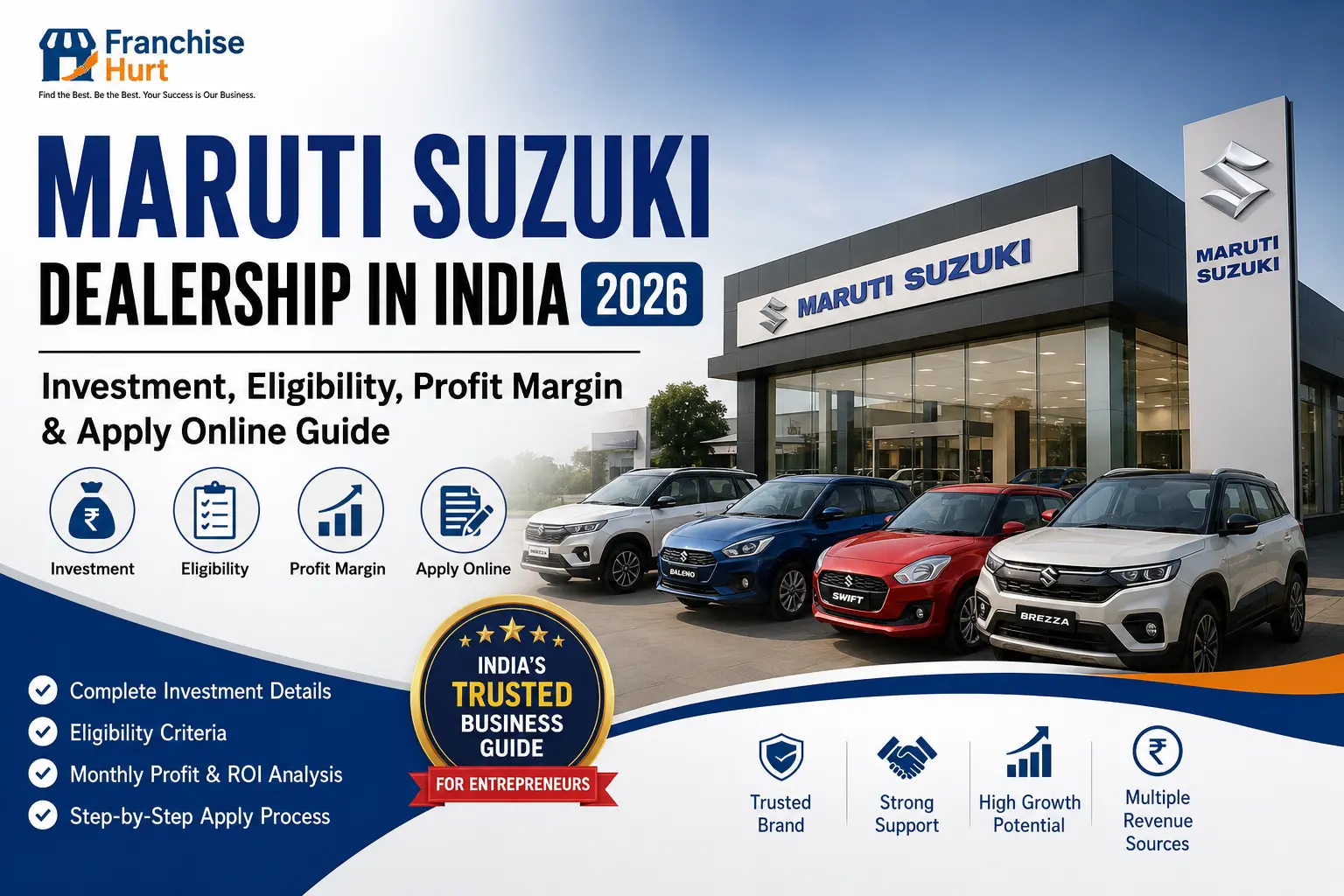
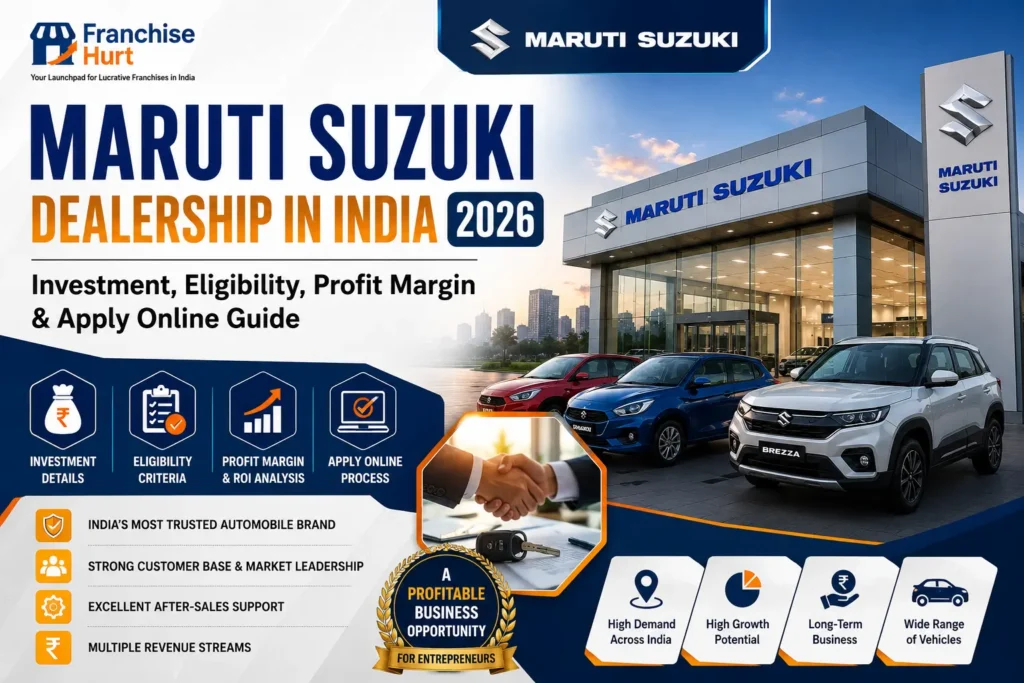
Maruti Suzuki Dealership in India 2026: Investment, Eligibility, Profit Margin & Apply Online Guide
India’s passenger vehicle market continues to grow as rising incomes, improved road infrastructure, and easier vehicle financing encourage more families and businesses to own personal vehicles. Among all automobile manufacturers, Maruti Suzuki India Limited has consistently maintained a leading position by offering reliable, fuel-efficient, and value-for-money vehicles supported by one of the country’s largest sales and service networks.
For entrepreneurs looking to enter the automobile retail industry, becoming an authorized Maruti Suzuki dealer can provide access to a well-established brand, a diversified product portfolio, structured dealer support, and multiple recurring revenue streams. Unlike independent automobile retailers, authorized dealers benefit from standardized operating procedures, technical training, genuine spare parts supply, and strong customer trust.
This guide explores everything you need to know about starting a Maruti Suzuki Dealership in India, including the dealership business model, estimated investment, infrastructure requirements, income potential, application process, and practical insights to help you evaluate whether this opportunity matches your business goals.
| Brand | Maruti Suzuki India Limited |
| Industry | Passenger Automobile Manufacturing |
| Founded | 1981 |
| Headquarters | New Delhi, India |
| Business Type | Authorized Dealership |
| Estimated Investment | ₹2 Crore – ₹6 Crore+* |
| Space Requirement | As per company dealership standards |
| Official Website | Visit Website ↗ |
| Dealer Enquiry | Contact Maruti Suzuki ↗ |
Table of Contents
Brand Overview
Maruti Suzuki is India’s largest passenger vehicle manufacturer, serving millions of customers through an extensive network of dealerships and service centers. The company focuses on providing affordable, reliable, and fuel-efficient mobility solutions for individuals, families, and businesses.
Unlike manufacturers that primarily target premium buyers, Maruti Suzuki offers vehicles across multiple price segments, making car ownership accessible to a wide customer base. This broad market presence enables dealers to serve first-time buyers, fleet operators, professionals, and families under a single brand.
The company operates through two retail formats:
- Arena – Mass-market dealerships offering popular passenger vehicles.
- NEXA – Premium retail network designed for customers seeking an enhanced showroom experience and higher-end models.
With a combination of strong brand recognition, nationwide service coverage, and continuous product innovation, Maruti Suzuki has remained a preferred choice for customers and entrepreneurs alike.
📢 Did You Know?
Maruti Suzuki has consistently been among India’s highest-selling passenger vehicle manufacturers, supported by an extensive dealership and service network that reaches urban, semi-urban, and rural markets. This wide presence helps customers access vehicle sales, servicing, and genuine spare parts more conveniently.
Company Journey & Growth
Maruti Suzuki began operations in 1981 as a joint venture between the Government of India and Suzuki Motor Corporation of Japan. At a time when personal mobility options were limited, the company introduced modern, fuel-efficient passenger vehicles that transformed India’s automobile market.
The launch of the iconic Maruti 800 marked a turning point, making car ownership more accessible to Indian households. Over the years, the company expanded its product portfolio to include hatchbacks, sedans, SUVs, MPVs, CNG vehicles, and hybrid models, catering to a diverse customer base.
Today, Maruti Suzuki has:
- A nationwide sales and service network.
- Manufacturing facilities in Haryana and Gujarat.
- Two retail channels—Arena and NEXA.
- A strong portfolio of passenger vehicles across multiple price segments.
- A continued focus on cleaner mobility solutions, digital retail experiences, and customer satisfaction.
Its consistent investment in manufacturing, technology, and dealership expansion has helped the company maintain a leading position in India’s passenger vehicle market.
Also Read: BYD India Dealership
Founder Vision
Maruti Suzuki’s growth is the result of a collaborative vision between the Government of India and Suzuki Motor Corporation. The objective was to make modern, reliable, and fuel-efficient cars affordable for Indian consumers while developing a strong domestic automobile manufacturing ecosystem.
Over the decades, the company has continued this vision by focusing on quality, innovation, safety, and customer-centric services, enabling millions of families to own their first car.
📈 Industry Snapshot
India is one of the world’s largest passenger vehicle markets. Growth is supported by increasing household incomes, expanding highway infrastructure, improved financing options, and a growing preference for personal mobility. The market is also evolving with higher demand for SUVs, CNG vehicles, hybrid technology, and electric mobility solutions.
Why This Business is Growing
Several long-term trends continue to support demand for authorized automobile dealerships:
- Rising middle-class purchasing power.
- Increasing vehicle ownership in Tier-2 and Tier-3 cities.
- Growing preference for personal transportation.
- Easier access to vehicle financing.
- Expanding road and highway infrastructure.
- Demand for CNG and fuel-efficient vehicles.
- Recurring revenue opportunities through servicing, spare parts, and accessories.
For dealership owners, these factors create opportunities to generate both one-time sales income and long-term recurring revenue.
💡 Franchise Hurt Expert Tip
Before investing in a Maruti Suzuki dealership, request detailed information about the dealership agreement, territory allocation, showroom specifications, inventory requirements, working capital expectations, warranty obligations, and performance metrics. Understanding these factors early can help you make a more informed investment decision.
Maruti Suzuki Dealership Business Model
Maruti Suzuki primarily operates through an authorized dealership model, where approved partners sell vehicles under the company’s established retail network. Dealers are responsible for providing a complete customer experience that typically includes vehicle sales, finance assistance, insurance facilitation, after-sales service, genuine spare parts, and accessories.
The business generates revenue from multiple channels rather than relying solely on vehicle sales. Dealerships benefit from recurring customer visits for servicing, maintenance, and parts replacement, helping create long-term business opportunities beyond the initial purchase.
💰 Investment Snapshot
💰 Estimated Investment Snapshot
Showroom & Interiors
₹50L–₹1.5Cr
Workshop Setup
₹40L–₹1Cr
Vehicle Inventory
₹80L–₹3Cr+
Total Investment*
₹2Cr–₹6Cr+
*Estimated values prepared by Franchise Hurt using industry benchmarks. Maruti Suzuki India Limited does not publicly disclose a fixed dealership investment applicable to every location.
Investment Breakdown
Unlike many franchise businesses, a Maruti Suzuki dealership requires a significant capital investment because it combines a vehicle showroom, service workshop, spare parts inventory, trained workforce, and working capital under one business model.
Each cost component serves a specific purpose in ensuring the dealership meets the company’s operational standards and customer expectations.
💰 Estimated Investment Breakdown
| Investment Item | Estimated Cost | Purpose |
|---|---|---|
| Showroom Setup | ₹50L – ₹1.5Cr | Customer experience, vehicle display, interiors and branding. |
| Workshop Equipment | ₹40L – ₹1Cr | Service bays, lifts, diagnostic tools and workshop setup. |
| Vehicle Inventory | ₹80L – ₹3Cr+ | Stock vehicles for immediate customer delivery. |
| Spare Parts | ₹20L – ₹60L | Support after-sales service and repairs. |
| Working Capital | ₹50L – ₹1.5Cr | Daily operations, salaries, utilities and inventory replenishment. |
| Total Estimated Investment | ₹2 Crore – ₹6 Crore+* | |
Why Each Investment Matters
Showroom Interiors
The showroom represents the brand’s image and customer experience. Investments include customer lounge, vehicle display area, lighting, branding, furniture, and digital displays.
Workshop Equipment
A fully equipped workshop enables dealers to provide maintenance, repairs, warranty services, diagnostics, and routine servicing, creating an important recurring revenue stream.
Vehicle Inventory
Dealerships are expected to maintain a stock of vehicles to support customer demand and timely deliveries. Inventory requirements vary based on dealership size and local demand.
Spare Parts
Maintaining genuine spare parts ensures faster service turnaround, improved customer satisfaction, and consistent after-sales revenue.
🚀 Looking for the Right Dealership?
Explore detailed dealership guides, investment insights, and business opportunities across India’s leading automobile, EV, FMCG, and industrial brands.
Explore More Dealerships →Office & IT Infrastructure
Modern dealerships rely on computers, billing systems, CRM software, networking equipment, and finance desks to manage daily operations efficiently.
Staff & Training
Recruiting qualified sales executives, service advisors, technicians, and support staff is essential for delivering a professional customer experience.
Working Capital
Working capital supports daily operations such as salaries, utility bills, inventory replenishment, marketing expenses, and other operational costs during the initial months.
🚀 List Your Franchise or Dealership with Franchise Hurt
Reach thousands of entrepreneurs actively searching for franchise, dealership, distributorship, and business opportunities across India. Submit your business today and increase your brand visibility—for FREE!
List Your Franchise & Dealership FREE →💡 Franchise Hurt Investment Note
Investment requirements vary depending on:
- Arena or NEXA dealership format
- City category
- Market demand
- Inventory levels
- Infrastructure specifications
- Company-approved dealership standards
Always verify the latest commercial requirements directly with Maruti Suzuki before making any investment.
Estimated Monthly Income
📈 Estimated Monthly Income
Revenue
₹70L–₹4Cr+
Operating Expenses
Varies
Estimated Net Profit*
₹10L–₹50L+
Estimated Break-even
3–6 Years
Franchise Hurt Profit Disclaimer: These figures are estimates based on industry benchmarks and dealership business models. Maruti Suzuki does not publish standard dealer profits. Actual results depend on vehicle sales, service income, inventory turnover, operating costs, and local market conditions.
Revenue Sources
One of the biggest strengths of a Maruti Suzuki dealership is that income is generated from multiple business activities rather than relying only on vehicle sales.
| Revenue Stream | Description |
|---|---|
| 🚗 New Vehicle Sales | Primary source of business revenue. |
| 🔧 Service & Maintenance | Scheduled servicing, repairs, and warranty work. |
| 🛠 Genuine Spare Parts | Regular replacement parts for customers. |
| 🎁 Accessories | Seat covers, floor mats, infotainment systems, alloy wheels, and more. |
| 🏦 Finance Assistance | Commission from partner banks and NBFCs. |
| 📄 Insurance Services | Motor insurance and renewals. |
| 🛡 Extended Warranty | Optional protection plans and annual maintenance packages. |
🏢 Space & Infrastructure
🏢 Ideal Dealership Infrastructure
📍 Prime Location
Main roads or high-visibility commercial corridors with easy customer access.
🚗 Parking
Dedicated customer parking and vehicle display space.
🔧 Workshop
Integrated service center with modern equipment and service bays.
📦 Storage
Secure storage for genuine spare parts and accessories.
👤 Who Should Invest?
👨💼 Entrepreneurs
Ideal for individuals planning to build a long-term automobile retail business.🏢 Existing Business Owners
Suitable for companies looking to diversify into the automobile sector.💼 Investors
Best for investors with adequate capital seeking a scalable business.🚗 Automobile Professionals
Recommended for those with prior automotive sales or service experience.👨👩👧 Family Businesses
Well suited for families planning to build a multi-generation enterprise.🏬 Commercial Property Owners
Beneficial for owners of strategically located commercial properties that meet dealership requirements.Also Read: TVS Bike Dealership
Documents Required
🪪 Personal
- Aadhaar Card
- PAN Card
- Photographs
- Address Proof
🏢 Business
- GST Registration
- Business Registration
- Company Documents
💰 Financial
- IT Returns
- Bank Statements
- Net Worth Proof
🏠 Property
- Ownership/Lease Documents
- Site Layout
- Building Approvals
Technology & Operations
Modern Maruti Suzuki dealerships rely on digital systems to streamline sales, customer relationship management, inventory control, workshop scheduling, and billing. Dealers are generally expected to maintain technology infrastructure that supports efficient operations and enhances the customer experience.
Key operational areas include:
- Digital customer enquiry management.
- Vehicle booking and delivery coordination.
- Workshop scheduling and job card management.
- Genuine spare parts inventory tracking.
- Customer feedback and service reminders.
- Finance and insurance coordination.
- Sales reporting and performance monitoring.
By integrating these systems with trained staff and standardized processes, dealerships can improve operational efficiency, deliver better customer service, and build long-term customer relationships.
Dealer Support from Maruti Suzuki
One of the key benefits of becoming an authorized Maruti Suzuki dealer is access to structured support throughout the dealership lifecycle. While the exact support package depends on the dealership agreement, dealers generally receive guidance in business operations, branding, training, and after-sales services.
🎓 Training
Product knowledge, sales skills, technical workshops and customer service training.📣 Marketing
National campaigns, showroom branding guidelines and promotional support.🛠 Technical Support
Service manuals, diagnostic systems and technical guidance.📦 Supply Chain
Vehicle allocation, genuine spare parts supply and accessories support.Best Cities to Start a Maruti Suzuki Dealership
The success of a dealership depends largely on selecting the right market. Instead of focusing only on metropolitan cities, investors should evaluate population growth, purchasing power, infrastructure development, and competition.
📍 Best Cities for a Maruti Suzuki Dealership
Hyderabad
Rapid urban growth, expanding suburbs, and consistent demand for passenger vehicles make Hyderabad a strong market.
Bengaluru
High purchasing power, growing IT workforce, and a large middle-class customer base.
Pune
A major automotive hub with a strong manufacturing ecosystem and increasing vehicle ownership.
Ahmedabad
Strong industrial growth and rising demand from families and business owners.
Lucknow
Expanding infrastructure and growing automobile demand in North India.
Coimbatore
Thriving SME sector, rising disposable income, and steady passenger vehicle demand.
Franchise Hurt Insight: Tier-2 cities often provide excellent long-term opportunities because competition is generally lower while demand continues to grow.
⚖️ Competitor Comparison
Choosing the right automobile brand is just as important as choosing the right location.
| Feature | Maruti Suzuki | Hyundai | Tata Motors | Mahindra |
|---|---|---|---|---|
| Market Position | Industry Leader | Strong Challenger | Fast Growing | SUV Leader |
| Product Range | Hatchback, Sedan, SUV, MPV, CNG, Hybrid | Hatchback, Sedan, SUV, EV | Cars, SUVs, EVs | SUVs & Pickups |
| Estimated Investment* | ₹2–6 Cr+ | ₹2–6 Cr+ | ₹2–6 Cr+ | ₹2–7 Cr+ |
| Dealer Network | Extensive | Wide | Growing | Strong |
| After-Sales Support | Excellent | Strong | Strong | Strong |
| Best For | Mass Market | Urban Customers | Safety & EV Buyers | SUV Customers |
*Investment figures are indicative industry estimates and may vary by location, dealership format, and company requirements.
✔ Advantages vs ⚠ Challenges
✔ Advantages
⚠ Challenges
Common Mistakes New Dealers Make
Many dealership businesses struggle because of poor planning rather than poor market demand.
Avoid these common mistakes:
- Choosing a location with limited customer visibility.
- Underestimating working capital needs.
- Focusing only on vehicle sales instead of recurring service revenue.
- Recruiting untrained staff.
- Maintaining inadequate spare parts inventory.
- Ignoring digital marketing and local branding.
- Not prioritizing customer satisfaction and retention.
- Expanding operations too quickly without stable cash flow.
Submit Enquiry
Fill out the official dealership enquiry form with your business details.
Initial Discussion
The dealership team reviews your profile and contacts eligible applicants.
Location Review
Your proposed location is assessed based on market potential and accessibility.
Commercial Evaluation
Business capability, investment capacity, and infrastructure are evaluated.
Agreement & Training
After approval, complete documentation and attend dealer training.
Launch
Set up the dealership and begin serving customers.
Is This Dealership Worth Buying?
Yes, if you:
- Have the financial capacity for a large-scale business.
- Want to build a long-term automobile retail business.
- Can manage a professional sales and service team.
- Are prepared to invest in customer experience and after-sales support.
It may not be suitable if you are looking for a low-investment business or prefer a passive investment model.
Future Outlook
India’s passenger vehicle market is expected to remain one of the world’s largest over the coming years. Demand is likely to be supported by increasing household incomes, infrastructure development, easier vehicle financing, and continued interest in fuel-efficient, CNG, hybrid, and electric vehicles.
For authorized dealers, long-term growth is expected to come not only from vehicle sales but also from recurring revenue through servicing, genuine spare parts, accessories, finance, and insurance.
Conclusion
Becoming an authorized Maruti Suzuki dealership can be an excellent long-term business opportunity for entrepreneurs with the financial capacity, operational expertise, and commitment to delivering exceptional customer service. As India’s leading passenger vehicle manufacturer, Maruti Suzuki offers a trusted brand, a wide product portfolio, an extensive sales and service network, and multiple recurring revenue streams through servicing, genuine spare parts, accessories, finance, and insurance.
However, a dealership is a significant investment and should not be viewed as a quick-profit business. Success depends on selecting the right location, maintaining sufficient working capital, building a skilled team, achieving operational efficiency, and consistently delivering a superior customer experience. Thorough market research and a clear understanding of the dealership agreement are essential before making any financial commitment.
Explore Other Dealerships Opportunities
Frequently Asked Questions(FAQs)
1. Does Maruti Suzuki offer dealership opportunities?
Ans: Yes. The company appoints authorized dealers based on market potential and business requirements.
2. How much investment is required?
Ans: The estimated investment typically ranges from ₹2 crore to ₹6 crore or more, depending on the dealership format and location.
3. Does Maruti Suzuki provide training?
Ans: Yes. Authorized dealers generally receive sales, product, technical, and operational training.
4. Can I apply online?
Ans: Yes. Interested applicants can submit a dealership enquiry through the official Maruti Suzuki website.
5. What are the major revenue sources?
Vehicle sales, servicing, spare parts, accessories, finance facilitation, insurance, and extended warranty services.
📚 References
- Maruti Suzuki India Limited – Official Website
- Society of Indian Automobile Manufacturers (SIAM)
- Ministry of Heavy Industries
- Maruti Suzuki Annual Reports
- Official company announcements and investor presentations