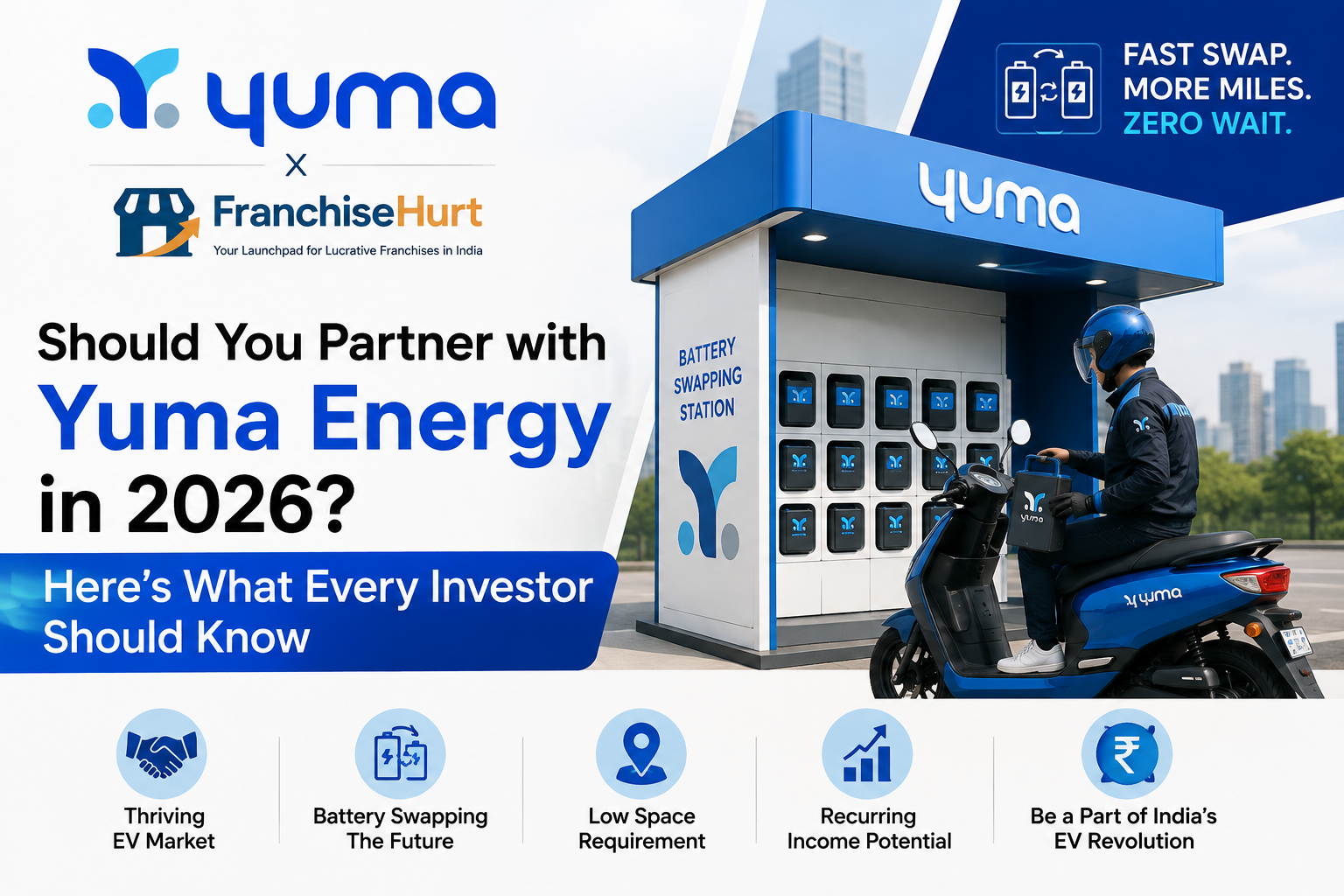
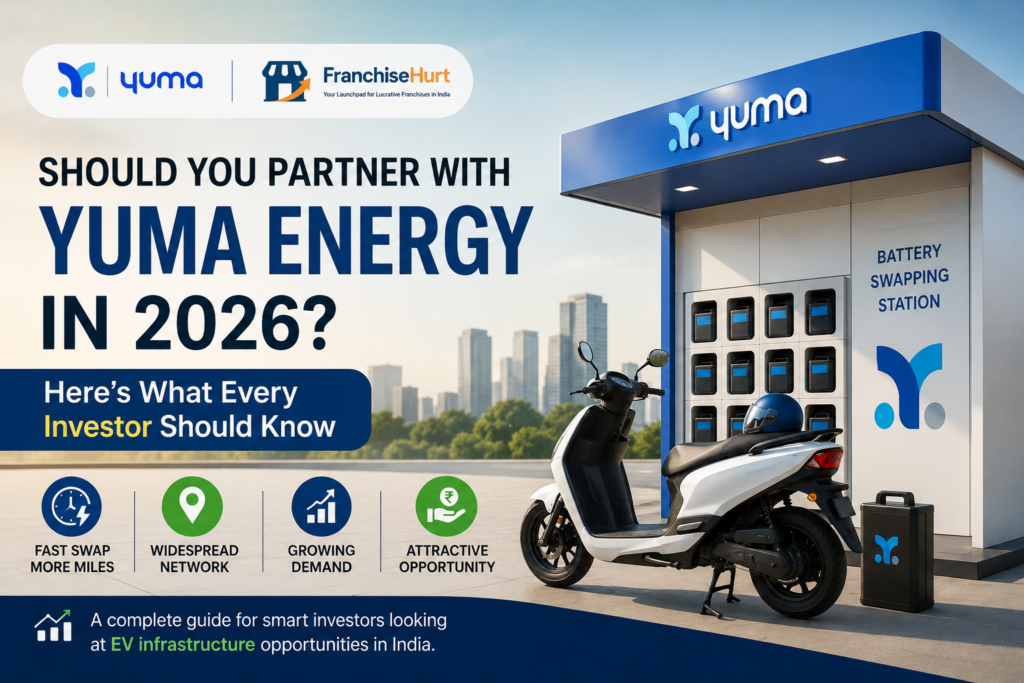
Should You Partner with Yuma Energy in 2026? Here’s What Every Investor Should Know
Quick Summary
Looking for an EV business opportunity in India? Yuma Energy’s battery-swapping partner program is attracting attention as electric two-wheelers become more common. But is it the right investment for you? This guide explains how the business works, estimated costs, who it’s suitable for, and the key factors to evaluate before applying.
Table of Contents
Why Everyone Is Talking About Battery Swapping
Electric vehicles are becoming a common sight on Indian roads, especially among delivery riders and commercial fleet operators. While EV adoption continues to grow, charging time remains one of the biggest challenges for businesses that depend on keeping vehicles on the road.
This is where battery swapping comes into the picture.
Instead of waiting for a battery to recharge, a rider can exchange a discharged battery for a fully charged one within a few minutes and continue the journey. For businesses that rely on fast turnaround times, this approach can reduce downtime and improve productivity.
As demand for this service grows, companies are expanding their battery-swapping networks across Indian cities. Yuma Energy is one of the companies working in this space.
What Is Yuma Energy?
Yuma Energy is an electric mobility infrastructure company that focuses on battery swapping for compatible electric two-wheelers and commercial fleets. Rather than operating traditional EV charging stations, the company has built a network of swapping stations where riders can replace a discharged battery with a charged one.
The company is backed by Yulu and Magna, and its network continues to expand across multiple cities in India.
For business owners, Yuma’s expansion creates an opportunity to become a local partner by hosting a battery-swapping station in a suitable commercial location.
Also Read: Battery Smart Franchise
Is Yuma Energy a Franchise?
This is one of the most common questions people search online.
The short answer is no—not in the traditional sense.
Yuma Energy describes its model as a partner program rather than a conventional franchise. Instead of running a retail outlet, approved partners typically provide space for a battery-swapping station while Yuma manages the technology, batteries, software, and operational ecosystem.
This makes it quite different from opening a restaurant, café, or retail franchise.
Why Is This Business Opportunity Growing?
Battery swapping is closely linked to the rise of commercial electric vehicles. As more delivery services, fleet operators, and businesses shift towards electric mobility, the need for quick battery replacement is expected to increase.
Some of the key factors driving demand include:
- Faster turnaround compared with conventional charging
- Increasing use of electric two-wheelers for deliveries
- Growth of e-commerce and quick-commerce services
- Government support for EV adoption
- Lower downtime for commercial riders
These trends create opportunities for businesses that can provide convenient battery-swapping locations.
Before You Think About Investing
Before looking at investment figures or expected returns, it’s worth asking yourself a few practical questions.
✔ Do you already own or lease commercial space?
✔ Is your property located in an area with regular EV traffic?
✔ Are delivery riders or fleet operators active nearby?
✔ Can the location remain accessible throughout the day?
✔ Are you looking for a long-term infrastructure business rather than a short-term investment?
If your answer is “yes” to most of these questions, it may be worth exploring the Yuma Energy partner program further.
What You’ll Learn in This Guide
In the rest of this article, we’ll cover:
- How the Yuma Energy partner model works
- Estimated investment and operating costs
- Revenue opportunities and factors that influence earnings
- Location requirements
- Advantages and potential challenges
- Questions you should ask before applying
- The official application process
- Our final assessment of whether this opportunity is worth considering in 2026
How Does the Yuma Energy Partner Model Work?
Unlike a restaurant or retail franchise, Yuma Energy doesn’t expect partners to sell products directly to customers. The business revolves around supporting electric vehicle users through a battery-swapping network.
Here’s a simple way to understand it.
Imagine you’re a delivery rider using an electric scooter. Instead of waiting an hour or more to charge the battery, you stop at a nearby Yuma station, swap your discharged battery for a fully charged one, and continue your work within minutes.
The partner’s role is to provide a suitable location where this swapping station can operate efficiently, while Yuma Energy manages the battery technology, software platform, and operational ecosystem.
This means the business is closer to an infrastructure partnership than a traditional retail franchise.
Where Does the Revenue Come From?
One question many readers ask is, “How does a Yuma partner actually earn?”
The answer depends on the agreement between Yuma Energy and its partners. While the company does not publicly disclose every commercial detail, revenue is generally linked to the operation of battery-swapping stations and the usage of the network.
The more frequently compatible EV users visit the station, the greater the potential activity.
Several factors can influence earnings, including:
- The number of compatible electric vehicles in the area.
- Daily battery swap volume.
- Location visibility and accessibility.
- Nearby delivery hubs and commercial activity.
- Overall EV adoption in the city.
Rather than thinking of it as a one-time sale, it’s better to view the business as a service that benefits from repeat usage.
How Much Should You Budget?
Yuma Energy has not published a complete investment breakup on its official website. The final cost can vary depending on the location, infrastructure requirements, and the partner agreement.
However, based on similar EV infrastructure projects, prospective partners should plan for expenses such as:
| Expense | Estimated Range* |
|---|---|
| Site preparation | ₹2–5 lakh |
| Electrical work | ₹1–3 lakh |
| Civil modifications | ₹1–2 lakh |
| Security deposit (if applicable) | Depends on agreement |
| Working capital | ₹2–5 lakh |
Note: These are indicative estimates based on industry observations and are not official Yuma Energy figures. Always confirm the latest commercial requirements directly with the company.
The Costs People Often Overlook
When planning any business, it’s easy to focus only on the initial investment. In reality, day-to-day operating expenses also play an important role.
Some of the ongoing costs to consider include:
- Electricity consumption
- Property rent (if applicable)
- Routine maintenance
- Security arrangements
- Staff salaries, where required
- Internet and communication services
- Local municipal charges
- Insurance
Preparing for these expenses from the beginning can help avoid financial pressure later.
Is This Opportunity Right for You?
Not every business suits every investor.
A Yuma Energy partner location may be a good fit if you:
- Already own or have access to commercial space.
- Are located in a city where electric two-wheelers are increasingly common.
- Want to participate in the growing EV ecosystem.
- Are comfortable managing a physical business location.
- Prefer a long-term infrastructure opportunity rather than a seasonal business.
Who Should Think Twice?
This opportunity may not be the best choice if:
- There is very little EV adoption in your area.
- Your property is difficult to access.
- You’re expecting quick profits without operational involvement.
- You have limited funds beyond the initial setup.
- You’re looking for a business that depends on walk-in retail customers.
Being honest about these factors before investing can help you make a more informed decision.
A Simple Location Checklist
Location plays a major role in the success of a battery-swapping station. Before applying, consider visiting your proposed site at different times of the day and asking yourself:
- Are electric scooters regularly passing through this area?
- Are there restaurants, grocery stores, or offices that employ delivery riders nearby?
- Is the station easy to locate from the main road?
- Can vehicles enter and exit safely?
- Is there enough space for smooth battery swapping operations?
A location with consistent commercial activity is generally more likely to support regular usage than one with only occasional traffic.
Practical Tip
One mistake many first-time investors make is assuming that every EV-related business will automatically perform well. In reality, demand depends heavily on local conditions. Before committing to any infrastructure investment, spend a few hours observing the area, speak with local business owners, and assess whether compatible EV users are already active nearby. A little research today can save significant costs later.
What Should You Ask Yuma Energy Before You Apply?
Most entrepreneurs spend weeks comparing investment figures but only a few minutes talking to the company. That’s often a mistake.
Before signing any agreement, prepare a list of practical questions. The answers will help you understand whether the opportunity fits your location and investment goals.
Some useful questions include:
- What support will Yuma provide during the setup process?
- Who is responsible for equipment maintenance?
- Are batteries owned by Yuma or the partner?
- How is partner revenue calculated?
- What is the expected setup timeline?
- Does the company provide technical training?
- Is there any minimum contract period?
- What happens if the station records lower-than-expected usage?
Getting clarity on these points can help you make a more informed investment decision.
How Can You Apply to Become a Yuma Energy Partner?
If you’re interested in exploring this opportunity further, the application process starts through Yuma Energy’s official website.
The company generally reviews applications based on factors such as:
- Availability of a suitable commercial location
- Local EV demand
- Accessibility of the site
- Infrastructure readiness
- Business potential in the surrounding area
Once your enquiry is submitted, the Yuma team may contact shortlisted applicants to discuss the next steps, evaluate the proposed location, and explain the commercial model in more detail.
⚡ Interested in Becoming a Yuma Partner?
If you have a suitable location and want to explore opportunities in India’s growing EV battery-swapping ecosystem, visit Yuma Energy’s official partner page to learn more and submit your enquiry.
🚀 Apply to Become a Yuma Partner →Things to Check Before Making a Decision
Instead of getting excited about the EV industry, spend some time evaluating your own location.
Ask yourself:
✔ Are there food delivery riders operating nearby?
✔ Is there enough commercial activity throughout the day?
✔ Are electric scooters already common in the area?
✔ Can customers access the location easily?
✔ Will the business still make sense if EV adoption grows gradually instead of rapidly?
These questions are often more important than the initial investment itself.
Advantages
Every business has strengths, and Yuma Energy offers several features that make it worth considering.
- Operates in a fast-growing EV ecosystem.
- Battery swapping reduces charging downtime.
- Requires comparatively less space than many EV charging stations.
- Supported by an established technology platform.
- Backed by experienced industry partners.
- Suitable for commercial properties with good accessibility.
- Opportunity to participate in India’s expanding clean mobility sector.
- Growing network across multiple cities.
Challenges You Should Keep in Mind
Like any infrastructure business, success isn’t guaranteed.
Some factors that could affect performance include:
- EV adoption varies from one city to another.
- Demand depends on compatible vehicles using the network.
- Commercial location plays a significant role.
- Infrastructure businesses often require patience before reaching full utilization.
- Revenue may grow gradually rather than immediately.
Understanding these realities helps set realistic expectations.
My Take
After reviewing Yuma Energy’s business model, one thing stands out—it isn’t trying to compete with traditional fuel stations or conventional EV charging points. Instead, it focuses on solving a practical problem for commercial EV users: reducing downtime.
That makes the opportunity interesting, particularly in cities where electric delivery fleets are already active.
However, I wouldn’t evaluate this business based only on projected returns. I’d first look at the local EV ecosystem, nearby fleet operators, and the long-term demand for battery swapping in the area. In infrastructure businesses, the right location often matters more than the brand name alone.
Should You Consider Becoming a Yuma Energy Partner?
It could be a good fit if:
- You already own commercial property.
- Your location has regular EV movement.
- You’re interested in long-term infrastructure businesses.
- You can manage a physical site or have someone who can.
You may want to reconsider if:
- You’re looking for quick returns.
- Your area has very limited EV adoption.
- You don’t have sufficient working capital.
- You’re expecting the business to run without involvement.
Final Thoughts
India’s EV infrastructure is still evolving, and battery swapping is one of the models attracting attention from both mobility companies and investors. Yuma Energy has built a network around this concept and is expanding through local partners in selected locations.
If you’re considering this opportunity, avoid making a decision based solely on industry trends. Visit your proposed location, understand the local EV ecosystem, speak with the company, and compare it with other infrastructure opportunities before investing.
A well-informed decision today is likely to be more valuable than rushing into a growing market without proper evaluation.
Explore Other Green and Sustainable Franchises
Frequently Asked Questions (FAQs)
1. Is Yuma Energy a franchise?
Ans: No. Yuma Energy operates a partner program rather than a traditional franchise model.
2. Who can apply?
Ans: Individuals, businesses, and commercial property owners with suitable locations may enquire through the official website.
3. Does Yuma provide technical support?
Ans: According to the company, partners receive operational and technology support as part of the program. Specific services may vary depending on the partnership agreement.
4. How much space is required?
Ans: Yuma indicates that some partner locations can be set up with approximately 200 sq. ft. of available space, depending on the site and project requirements.
5. Is battery swapping better than charging?
Ans: For commercial vehicles that need to stay on the road for long hours, battery swapping can significantly reduce downtime compared with conventional charging. The right solution depends on the type of vehicle and how it is used.
Sources
To ensure accuracy, this guide is based on publicly available information from:
- Yuma Energy Official Website – Partner Program and company information
- Ministry of Heavy Industries (Government of India) – EV policy initiatives
- India Brand Equity Foundation (IBEF) – Electric mobility market insights