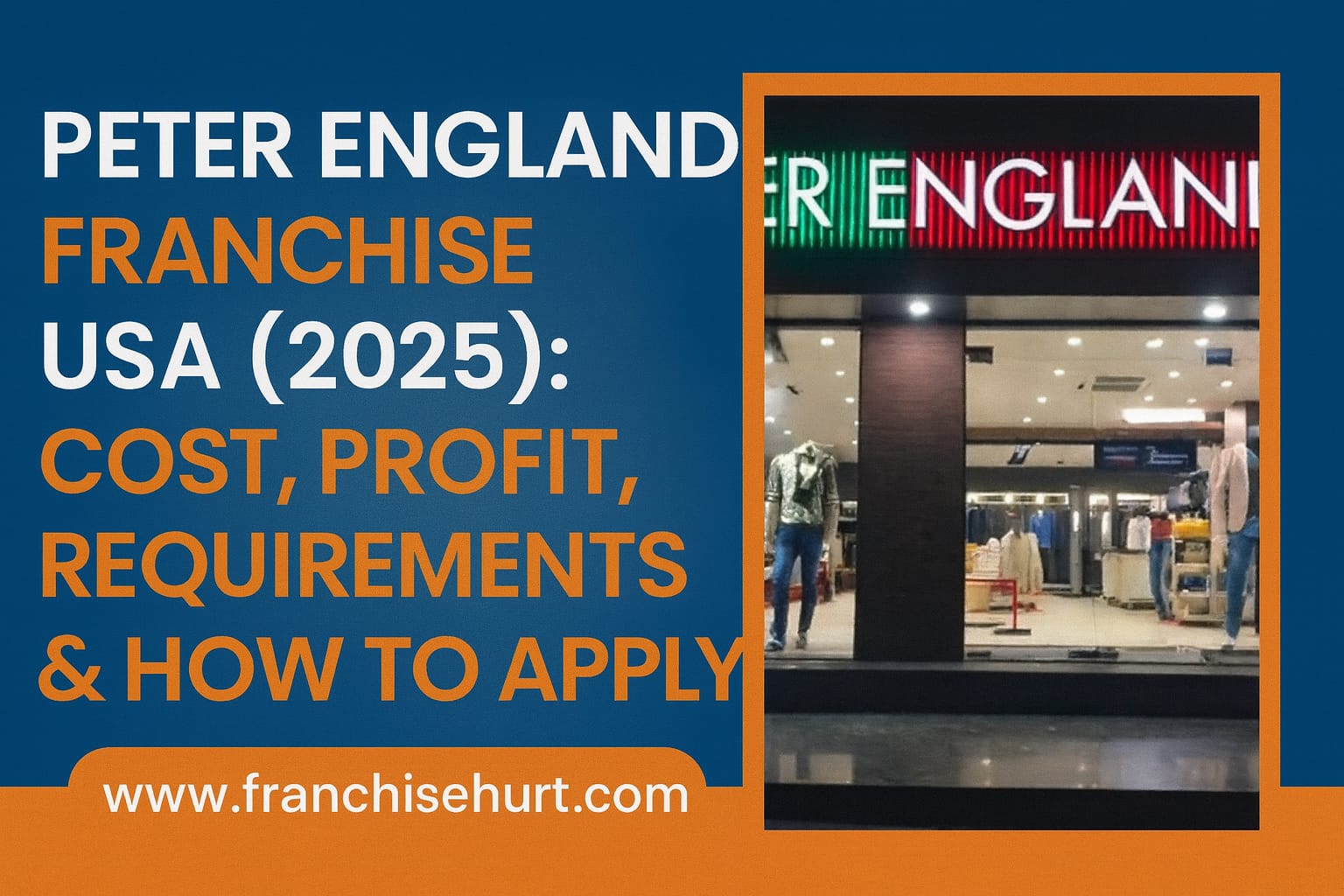
Peter England Franchise in 2025: Cost, Profit, Requirements & How to Apply
Quick Overview
| Aspect | Details |
|---|---|
| Brand | Peter England (Aditya Birla Fashion & Retail) |
| Founded / Origin | 1889 (Ireland); relaunched in India under ABFRL |
| Franchise Model | FOFO (Franchise Operated, Franchise Owned) |
| Estimated Investment | ₹ 20–30 lakh for 800–1,000 sq ft store |
| Payback Period | Approximately 1–2 years |
| Projected ROI | ~ 40% (depending on performance) |
| Franchise Duration | Typical 9 years or as negotiated |
| Support Provided | Store design, training, supply, purchase, marketing, POS |
| Franchise Contact | franchiseenquiry@abfrl.adityabirla.com |
Table of Contents
Introduction
Peter England is one of India’s most trusted names in men’s apparel, offering a complete range of formal and casual wear under the umbrella of Aditya Birla Fashion & Retail Ltd (ABFRL). For entrepreneurs wanting to build a retail fashion business with a stable brand, a Peter England franchise is a very attractive opportunity.
In this updated guide, we’ll deep-dive into: why it’s worthwhile, the origin story, market insights, investment details, profit potential, how to apply (with email template), comparison with competitors, and key pros and cons. By the end, you’ll have a strong foundation to decide whether to move ahead.
Why Consider a Peter England Franchise?
- Strong Brand Equity: Being part of ABFRL, Peter England benefits from established infrastructure, logistics, and brand trust.
- Broad Customer Base: Their product range spans formal, casual, and smart-casual, appealing to working professionals, college-goers, and more.
- Scalable Model: Existing stores across India show that the franchise model works in metro, tier-2, and tier-3 markets.
- Growth Potential: With ABFRL’s expansion strategy focused on emergent Indian cities, there’s room for new franchisees to grow.
- Reasonable Entry Cost: While the investment is moderate for retail, the potential returns and brand support justify it.
Founder & Origin Details
- Founding: Peter England dates back to 1889 in Ireland, giving it a classic, established brand heritage.
- Entry to India: Introduced in the 1990s (1997) by Madura Garments.
- Acquisition by ABFRL: The brand was acquired and scaled by the Aditya Birla Group, integrating into their fashion retail portfolio.
- Corporate Strength: ABFRL provides not just funding, but deep experience in retail operations, supply chain, and merchandising.
Research Insights & Market Potential
- Rapid Expansion: ABFRL is aggressively pushing Peter England into Tier-2 and Tier-3 cities, where branded men’s wear demand is rising.
- Product Innovation: The brand releases lines like sustainable Oxygeans denim, smart tech-finish shirts (e.g., water-resistant), and anti-wrinkle trousers.
- Winning Price Points: Many of their products target affordable-to-mid price segments, making it accessible to a large market.
- Local Adaptation: ABFRL often localizes inventory based on the region’s demand, which helps franchisees better match customer preferences.
Also Read: Patanjali Franchise in India (2025)
Investment Details
- Capital Requirement: ₹ 20–30 lakh is a reasonable estimate for initial setup (store + inventory + staffing).
- Store Size: Ideally around 800 to 1,000 sq ft, though this may vary based on location, format, or lease negotiation.
- Payback Period: With good sales, a well-run franchise could recover the investment in 1–2 years.
- ROI Estimate: Based on publicly available data, ROI could be ~ 40%, although this greatly depends on location, customer footfall, and inventory turnover.
- Agreement Term: Franchise contracts are commonly for 7–9 years, but terms may vary and be negotiated.
Profit Breakdown & Financial Projections
Here is a simplified monthly profit projection (hypothetical) for a Peter England franchise to give you an idea. (Note: Actuals will vary.)
| Item | Estimated Value (Monthly) |
|---|---|
| Sales Revenue | ₹ 6,00,000 (assuming modest footfall and ASP) |
| Cost of Goods Sold (COGS) | ₹ 3,00,000 (50% of sales – just an estimate) |
| Gross Margin | ₹ 3,00,000 |
| Operating Expenses: | |
| – Rent | ₹ 60,000 |
| – Staff Salaries | ₹ 40,000 |
| – Utilities + Maintenance | ₹ 20,000 |
| – Marketing / Local Promotions | ₹ 20,000 |
| – Miscellaneous | ₹ 10,000 |
| Total Opex | ₹ 1,50,000 |
| EBITDA (Before Depreciation) | ~ ₹ 1,50,000 |
| Return on Investment (Annualized) | ~ 36–45% (if similar trends persist monthly) |
This is a simplified model — real profitability will depend on your location, management efficiency, inventory loss, and promotions.
Competitor Comparison
Here’s how Peter England stacks up against other menswear brands, from a franchisee’s perspective.
| Brand | Estimated Investment | Target Market | Competitive Edge |
|---|---|---|---|
| Peter England | ₹ 20–30 L | Mid-range men’s wear | Strong national presence, affordable + formal + casual mix |
| Louis Philippe | Higher | Premium / Formal wear | More premium positioning, higher ASP, but narrower casual offering |
| Van Heusen | Medium-High | Office and formal wear | Well-known, trusted, but may lack the youth or casual diversification |
| Allen Solly | Medium | Smart casual + formal | Good for younger professionals, slightly different aesthetic |
This comparison helps you understand where Peter England stands in the competitive landscape and whether it aligns with your business vision.
What Peter England Provides to Franchisees
- Store Setup Support: Helps with design, layout, and branded fixtures.
- Training Program: Staff and management training in operations, merchandising, customer service.
- Inventory & Supply Chain: Reliable supply from ABFRL’s logistics network.
- POS / IT Systems: Access to POS software, billing, and inventory tracking tools.
- Marketing Assistance: National campaign alignment + local promotional support.
- Lease / Real Estate Guidance: Help in evaluating locations or negotiating commercial leases.
Required Documents
To apply, typically you will need:
- ID proof (PAN / Aadhar / Passport)
- Address proof (utility bill, lease agreement)
- Bank statements or proof of financial capacity (last 6–12 months)
- Proposed store site plan or photos
- Business experience resume or profile
- Agreement or proof for lease of retail space
Eligibility Criteria
- Capital: Able to invest in franchise cost + working capital.
- Location: Either lease or own a retail space (ideally ~800–1,000 sq ft).
- Business Experience: Not mandatory, but retail / management experience helps.
- Operational Role: Willingness to operate under FOFO model (active involvement).
- Brand Compliance: Agree to follow ABFRL’s store standards, merchandising, and operational SOPs.
How to Apply & Contact ABFRL
Step-by-Step Application Process
- Prepare Your Proposal
- Create a business plan: location, financials, sales forecast.
- Gather all required documents (ID proof, bank statements, lease plan, etc.).
- Send a Franchise Inquiry Email
Send an email expressing your interest in the Peter England franchise opportunity. An email template is provided below. - Send to ABFRL
- Email: franchiseenquiry@abfrl.adityabirla.com
- You can also use their Contact Us portal via their website. (ABFRL Contact Page)
- Site Visit & Negotiation
- ABFRL may inspect your proposed location and negotiate commercial terms, deposit, and contract duration.
- Store Setup & Training
- Once terms are agreed, ABFRL guides you through store design, staff hiring, and training.
- Launch & Ongoing Operations
- Plan a local launch event + promote via ABFRL marketing templates. Use their systems for POS, billing, and restocking.
Future Outlook
- Aggressive Expansion: ABFRL is expected to continue scaling Peter England in non-metro cities.
- Product Innovation: Growth likely in sustainable lines, smart tech fabrics, and hybrid casual-formal styles.
- Omnichannel Growth: Franchisees could benefit from offline + ABFRL’s online retail synergy.
- Localized Assortment: Increased tailoring of product selection to local tastes for better sales efficiency.
Government & Investment Support (India)
While no franchise-specific government grant is publicly available, potential support includes:
- MSME Registration: Registering as an MSME could unlock subsidized business credit or government schemes.
- Business Loans: You can approach banks / NBFCs for retail / franchise funding.
- State-Level Incentives: Some state governments offer tax rebates or capital grants for retail entrepreneurship.
- PMEGP / Startup Schemes: Programs like PMEGP (Prime Minister’s Employment Generation Programme) could be used if eligible.
Pros & Cons
Pros:
- Well-known brand backed by ABFRL
- Moderate initial investment in relation to brand value
- Strong support in operations, design, and marketing
- High growth potential in emerging Indian markets
- Diverse product range (formal + casual)
- Potential for good ROI if managed well
Cons:
- Inventory risk (unsold stock or overstock)
- High dependence on ABFRL’s supply chain and policies
- Significant operating expenses (rent, staff, utilities)
- Location risk: footfall and demographic mismatch can hurt sales
- Contractual obligations: design, SOPs, and renewal constraints
- Early cash flow risk: may take time to stabilize in first few months
Conclusion
A Peter England franchise stands out as a promising and scalable opportunity in India’s menswear retail sector. With ABFRL’s backing, solid brand recognition, and an accessible cost structure, it is very appealing. But to succeed, aspirant franchisees must plan carefully: pick the right location, build realistic financial models, and commit to high operational standards.
If you are serious about growing a fashion retail business and have the resources and drive, writing to ABFRL with a clear proposal (using the template above) is your first strong step. With wise execution, a Peter England franchise can not only be profitable but also deeply rewarding.
Frequently Asked Questions(FAQs)
1. How much capital do I need to start a Peter England franchise?
Ans: Around ₹ 20–30 lakh is estimated for store setup, inventory, and working capital.
2. What is the expected ROI?
Ans: Based on rough financial modeling, ROI could be in the 36–45% range, assuming steady sales and efficient cost management.
3. How long does it take to recover the investment?
Ans: The payback period is typically projected at 1–2 years, depending on location and performance.
4. What is the franchise duration?
Ans: Commonly 7–9 years, though this depends on the negotiated agreement.
5. How do I contact ABFRL to apply?
Ans: Email: franchiseenquiry@abfrl.adityabirla.com
Use the ABFRL Contact Us page for further communication.
6. Does ABFRL help with training and store setup?
Ans: Yes, they provide design, merchandising, training, supply chain, and IT system support.