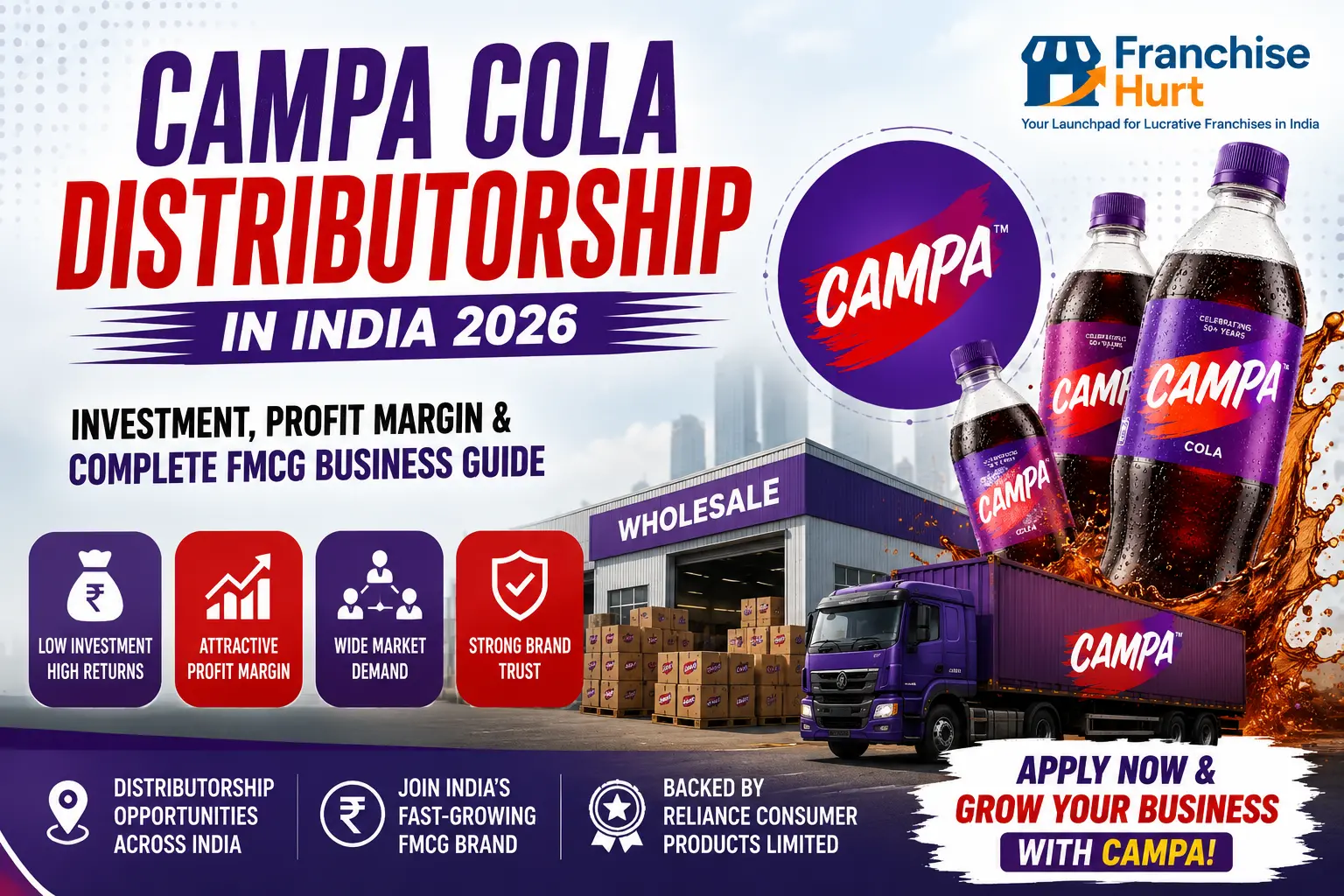
Campa Cola Distributorship in India 2026: Investment, Profit Margin & Complete FMCG Business Guide
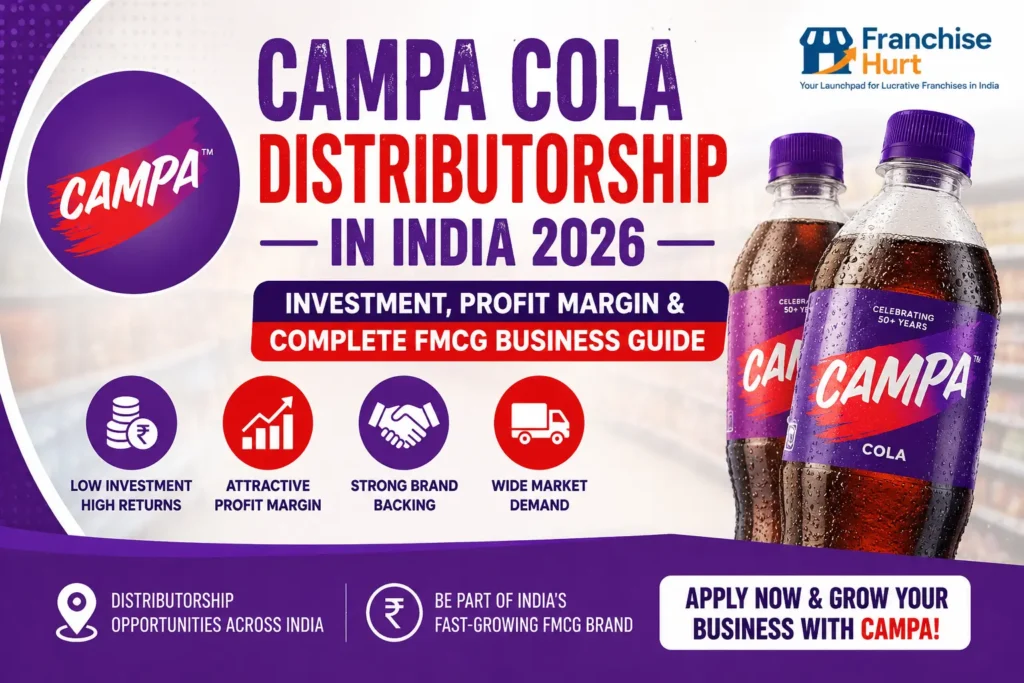
India’s soft drink and packaged beverage industry is one of the fastest-growing FMCG sectors, driven by a young population, rising disposable incomes, expanding retail networks, and increasing demand for affordable beverages. While global cola brands have dominated the market for decades, one iconic Indian brand has made a remarkable comeback—Campa Cola.
After being revived by Reliance Consumer Products Limited (RCPL), Campa Cola is once again becoming a familiar name in grocery stores, supermarkets, restaurants, and modern retail outlets across India. With Reliance’s extensive retail and distribution network, the brand is rapidly expanding its presence nationwide.
This resurgence has created interest among entrepreneurs looking to become distributors or channel partners for Campa products.
In this guide, you’ll learn everything about the Campa Cola distributorship business, including company history, founder story, business models, eligibility, investment considerations, infrastructure requirements, and the future potential of India’s beverage distribution market.
Quick Overview
| Particulars | Details |
|---|---|
| Brand | Campa Cola |
| Parent Company | Reliance Consumer Products Limited (RCPL) |
| Industry | FMCG – Soft Drinks & Beverages |
| Business Model | Distributor / Super Stockist / Channel Partner |
| Product Categories | Carbonated Soft Drinks, Packaged Drinking Water, Energy Drinks |
| Business Type | FMCG Distribution |
| Investment | Depends on Territory & Scale |
| Warehouse Requirement | Yes |
| Future Growth | Very High |
Table of Contents
About Campa Cola
Campa Cola is one of India’s most recognizable beverage brands.
Originally introduced during the 1970s, the brand became extremely popular when international cola brands temporarily exited the Indian market.
For many Indians, Campa Cola became synonymous with soft drinks and was widely available across the country before multinational competition returned during the 1990s.
In 2022, the brand was acquired and relaunched by Reliance Consumer Products Limited (RCPL), marking one of the biggest brand revivals in India’s FMCG sector.
Today, Campa products are available through Reliance’s expanding retail ecosystem and traditional distribution channels.
Also Read: VST Tractor Dealership
Founder Story & Brand History
The original Campa Cola brand was introduced by the Pure Drinks Group, one of India’s earliest soft drink manufacturers.
The company was founded by Charanjit Singh, whose vision helped establish Pure Drinks as one of India’s pioneering beverage companies.
When global cola companies were absent from India during the late 1970s and 1980s, Campa Cola became one of the country’s leading soft drink brands.
Popular slogans like “The Great Indian Taste” made the brand a household name.
After decades of limited market presence, the Campa brand was acquired by Reliance Consumer Products Limited, a subsidiary of Reliance Retail Ventures Limited, which is now investing significantly in reviving the brand across India.
The relaunch demonstrates Reliance’s strategy of strengthening its FMCG portfolio with trusted Indian brands while making them more accessible through its nationwide retail and distribution network.
About Reliance Consumer Products Limited (RCPL)
Reliance Consumer Products Limited is the FMCG business arm of Reliance Retail Ventures Limited.
The company focuses on developing and expanding consumer brands across categories such as:
- Packaged foods
- Beverages
- Home care
- Personal care
- Staples
- Confectionery
By leveraging Reliance’s retail presence, logistics capabilities, and supply chain infrastructure, RCPL aims to build strong Indian consumer brands with nationwide reach.
The revival of Campa Cola is one of the company’s flagship initiatives in the beverage segment.
Why Campa Cola Is Growing Again
Many entrepreneurs wonder why Campa Cola has returned to the market after many years.
Several factors explain the brand’s renewed growth.
Strong Reliance Retail Network
Reliance Retail operates one of India’s largest retail ecosystems.
This provides Campa products with access to:
- Reliance Smart stores
- Supermarkets
- Kirana stores
- Wholesale partners
- Modern trade outlets
- E-commerce channels
A robust distribution network significantly improves product availability.
Affordable Pricing Strategy
One of Campa’s biggest competitive advantages is its pricing strategy.
RCPL has positioned Campa products competitively, making them attractive to consumers seeking value-for-money beverages.
This helps retailers and distributors target a broader customer base.
Growing Beverage Market
India’s beverage consumption continues increasing due to:
- Urbanization
- Rising incomes
- Young population
- Hot climatic conditions
- Growing retail penetration
These factors create long-term opportunities for beverage distributors.
Research Insights & Market Trends
India’s non-alcoholic beverage industry is expected to continue expanding over the coming years.
According to the India Brand Equity Foundation (IBEF) FMCG Industry Report, India’s FMCG sector is among the country’s fastest-growing industries, supported by rising consumption and expanding distribution networks.
The Ministry of Food Processing Industries continues promoting food and beverage manufacturing through various initiatives aimed at strengthening India’s processing ecosystem.
Meanwhile, the Invest India FMCG Sector Overview highlights increasing opportunities in India’s consumer goods market due to demographic growth, organized retail expansion, and improving logistics infrastructure.
These trends provide a favorable environment for beverage distribution businesses.
Beverage Industry Data Points
| Market Indicator | Trend |
|---|---|
| Soft Drink Consumption | Increasing |
| Organized Retail | Expanding |
| FMCG Distribution | Strong Growth |
| Packaged Beverage Demand | Rising |
| Modern Trade | Growing |
| Rural FMCG Penetration | Increasing |
These trends indicate strong long-term potential for beverage distribution businesses.
Business Models for Campa Distribution
Unlike automobile dealerships or petrol pumps, Campa products are generally supplied through FMCG distribution channels.
Depending on the market and business requirements, opportunities may include the following models.
Distributor
Distributors purchase products from the company or an authorized channel and supply them to retailers within an allocated territory.
Typical responsibilities include:
- Inventory management
- Retailer servicing
- Order fulfillment
- Market expansion
- Sales team management
This is the most common FMCG business model.
Super Stockist
A Super Stockist generally operates at a larger scale than a distributor.
Responsibilities often include:
- Maintaining large inventories
- Supplying multiple distributors
- Managing warehouse operations
- Coordinating logistics
This model usually requires stronger financial capacity and larger infrastructure.
Retail Channel Partner
Retailers purchase products through authorized distributors or wholesalers for direct sale to consumers.
Examples include:
- Grocery stores
- Supermarkets
- Departmental stores
- Convenience stores
Who Can Apply?
Although RCPL does not publicly advertise a standardized Campa distributorship program, businesses with experience in FMCG distribution may have better opportunities when engaging with authorized distribution channels.
Suitable applicants generally include:
- Existing FMCG distributors
- Beverage wholesalers
- Super stockists
- Retail chain operators
- Logistics businesses
- Entrepreneurs with warehouse infrastructure
Previous FMCG distribution experience can be advantageous because beverage distribution requires inventory management, retailer servicing, and efficient logistics.
Infrastructure & Warehouse Requirements
Distribution businesses typically require suitable infrastructure for inventory storage and transportation.
Depending on the business scale, requirements may include:
- Warehouse space
- Delivery vehicles
- Loading and unloading area
- Inventory management systems
- Sales representatives
- Office facilities
The exact infrastructure depends on territory allocation and business volume.
Estimated Investment Breakdown
The total investment required for a Campa Cola distributorship depends on your business model, territory size, inventory requirements, warehouse capacity, and working capital. Since RCPL does not publicly disclose standardized investment requirements, the following figures are industry-based estimates for FMCG beverage distribution businesses.
| Investment Component | Estimated Cost |
|---|---|
| Security Deposit (if applicable) | ₹50,000 – ₹2 Lakhs* |
| Initial Product Inventory | ₹2 Lakhs – ₹10 Lakhs |
| Warehouse Setup | ₹1 Lakh – ₹5 Lakhs |
| Delivery Vehicle (Optional) | ₹5 Lakhs – ₹10 Lakhs |
| Office & Equipment | ₹50,000 – ₹2 Lakhs |
| Working Capital | ₹2 Lakhs – ₹10 Lakhs |
Estimated Total Investment
| Business Model | Estimated Investment |
|---|---|
| Retail Distributor | ₹5 Lakhs – ₹15 Lakhs |
| City Distributor | ₹10 Lakhs – ₹25 Lakhs |
| Super Stockist | ₹25 Lakhs – ₹75 Lakhs+ |
Estimated Profit Margin
Although RCPL does not publish official distributor margins, FMCG beverage distribution businesses generally operate within the following industry ranges:
| Revenue Source | Industry Estimate |
|---|---|
| Beverage Distribution Margin | 5% – 10% |
| Retail Supply Incentives | Performance Based |
| Volume Incentives | Company Policy |
| Seasonal Schemes | Variable |
The actual profitability depends on:
- Sales volume
- Distribution territory
- Retail network
- Operational efficiency
- Promotional schemes
⚠️ FranchiseHurt Investment Disclaimer
Disclaimer: The investment and margin figures mentioned above are estimated industry benchmarks based on publicly available information and common FMCG beverage distribution practices in India. Reliance Consumer Products Limited (RCPL) has not publicly announced standardized investment amounts, distributor fees, profit margins, or security deposit requirements for Campa Cola distributorships. Actual investment and commercial terms may vary depending on territory, inventory requirements, infrastructure, and company policies. FranchiseHurt recommends contacting RCPL or its authorized distribution representatives directly to verify the latest eligibility criteria, investment requirements, and business terms before making any investment decision.
Estimated Profit Margin
One of the most frequently asked questions by entrepreneurs is:
“How much profit can a Campa Cola distributor earn?”
Reliance Consumer Products Limited (RCPL) has not publicly disclosed official distributor margins. However, based on standard FMCG beverage distribution practices in India, distributors generally earn through product margins, volume incentives, seasonal schemes, and retailer expansion.
Industry-Based Estimated Profit Margins
| Revenue Source | Estimated Industry Range |
|---|---|
| Distributor Margin | 5% – 10% |
| Super Stockist Margin | 3% – 8% |
| Retailer Margin | 10% – 20% |
| Volume Incentives | Performance Based |
| Promotional Schemes | Seasonal & Company Policy |
What Determines Your Profit?
Your profitability depends on:
- Territory size
- Number of retailers served
- Product demand
- Monthly sales volume
- Warehouse efficiency
- Logistics costs
- Company incentive programs
Distributors with strong retailer networks and efficient supply chain management often achieve better business performance.
Documents Required
While requirements may vary depending on territory and business model, applicants generally need:
- Aadhaar Card
- PAN Card
- GST Registration
- Business Registration Certificate
- Shop & Establishment License (if applicable)
- Address Proof
- Bank Account Details
- Cancelled Cheque
- Warehouse Ownership/Lease Documents
- Passport-size Photographs
Additional documents may be requested during the verification process.
How to Apply for a Campa Cola Distributorship
Reliance Consumer Products Limited primarily expands Campa through distributors, wholesalers, and channel partners.
Step 1: Assess Your Business Readiness
Before applying, ensure you have:
- Sufficient investment capacity
- Warehouse or storage facility
- Distribution vehicle (optional but beneficial)
- Existing FMCG business experience (preferred)
- Retail network or sales team
Step 2: Contact the Company
Interested applicants can explore business opportunities through the official Campa and Reliance Consumer Products channels.
Official Website:
Reliance Consumer Products:
Reliance Consumer Products Limited
Business enquiries are also promoted through Campa’s LinkedIn business pages. Applicants should independently verify contact details before sharing documents or making any payments.
Step 3: Submit Business Details
You may be asked to provide:
- Business Profile
- Business Experience
- GST Details
- Warehouse Information
- Proposed Distribution Area
- Investment Capacity
- Contact Details
Step 4: Company Evaluation
The company or its authorized representatives may evaluate:
- Territory availability
- Business capability
- Distribution experience
- Infrastructure
- Market potential
Step 5: Agreement & Onboarding
If approved, further discussions regarding commercial terms, territory allocation, inventory planning, and onboarding may follow.
Why Choose Campa Cola Distribution?
Trusted Indian Brand
Campa is one of India’s most recognizable beverage brands with decades of brand recall.
Backed by Reliance
Reliance’s logistics network and retail ecosystem provide significant market reach.
Expanding Distribution Network
RCPL continues expanding its FMCG portfolio across India.
Strong Retail Demand
Carbonated beverages continue to remain a high-volume FMCG category across urban and rural markets.
Multiple Product Categories
Apart from Campa Cola, RCPL continues expanding its beverage portfolio, creating additional business opportunities for channel partners.
Challenges to Consider
Every FMCG distribution business has operational challenges.
Intense Competition
The soft drink industry is highly competitive.
Seasonal Demand
Demand often peaks during summer months.
Inventory Management
Proper stock rotation is essential for maintaining product quality.
Logistics
Timely delivery plays a crucial role in retailer satisfaction.
Working Capital
Distributors should maintain sufficient cash flow to support inventory purchases and daily operations.
Future Outlook
The future of Campa Cola appears promising due to several reasons.
Growing FMCG Market
India’s FMCG industry continues expanding with increasing consumer demand.
Rising Beverage Consumption
Packaged beverage consumption continues increasing across India.
Reliance Expansion Strategy
Reliance Consumer Products is investing in expanding its FMCG distribution footprint.
Retail Network Growth
Expansion of organized retail and traditional trade creates opportunities for distributors.
Brand Revival
Campa’s strong legacy and competitive pricing strategy position it well within India’s beverage market.
About This Analysis
This article is based on:
- Publicly available information from Reliance Consumer Products Limited and Campa.
- Industry reports from organizations such as the India Brand Equity Foundation (IBEF) and Invest India.
- General FMCG distribution practices in India.
The investment and profit estimates mentioned are industry benchmarks and not official figures published by RCPL.
Final Verdict
The revival of Campa Cola under Reliance Consumer Products Limited has created renewed interest among distributors, wholesalers, and FMCG entrepreneurs. Backed by one of India’s largest retail and supply chain networks, the brand has significant growth potential as it expands its presence across traditional trade, modern retail, and e-commerce channels.
For businesses with FMCG distribution experience, warehousing facilities, and a strong retailer network, a Campa Cola distributorship can be a promising opportunity. However, entrepreneurs should always verify territory availability, commercial terms, and eligibility requirements directly with RCPL or its authorized representatives before making any financial commitments.
Explore Other Dealership Franchises
Frequently Asked Questions (FAQs)
1. Is Campa Cola offering distributorships in India?
Ans: Campa products are distributed through Reliance Consumer Products Limited’s distribution network. Interested businesses can contact RCPL or authorized representatives to explore available opportunities.
2. How much investment is required?
Ans: RCPL has not publicly announced standardized investment requirements. Depending on the business model and territory, industry estimates range from approximately ₹5 Lakhs to ₹75 Lakhs+.
3. Is prior FMCG experience required?
Ans: While not always mandatory, experience in FMCG distribution, wholesale, or retail operations can be advantageous.
4. What infrastructure is required?
Ans: Applicants generally need:
Warehouse or storage facility
Working capital
Delivery capability
Sales and distribution network
5. Does RCPL publish official distributor margins?
Ans: No. RCPL has not publicly disclosed standardized distributor margins. Earnings depend on territory, sales volume, company schemes, and operational efficiency.
6. How can I increase my chances of approval?
Ans: Entrepreneurs with:
Existing FMCG distribution experience
Strong retailer relationships
Adequate warehouse infrastructure
Financial capability
Efficient logistics
may be better positioned for distribution opportunities.