
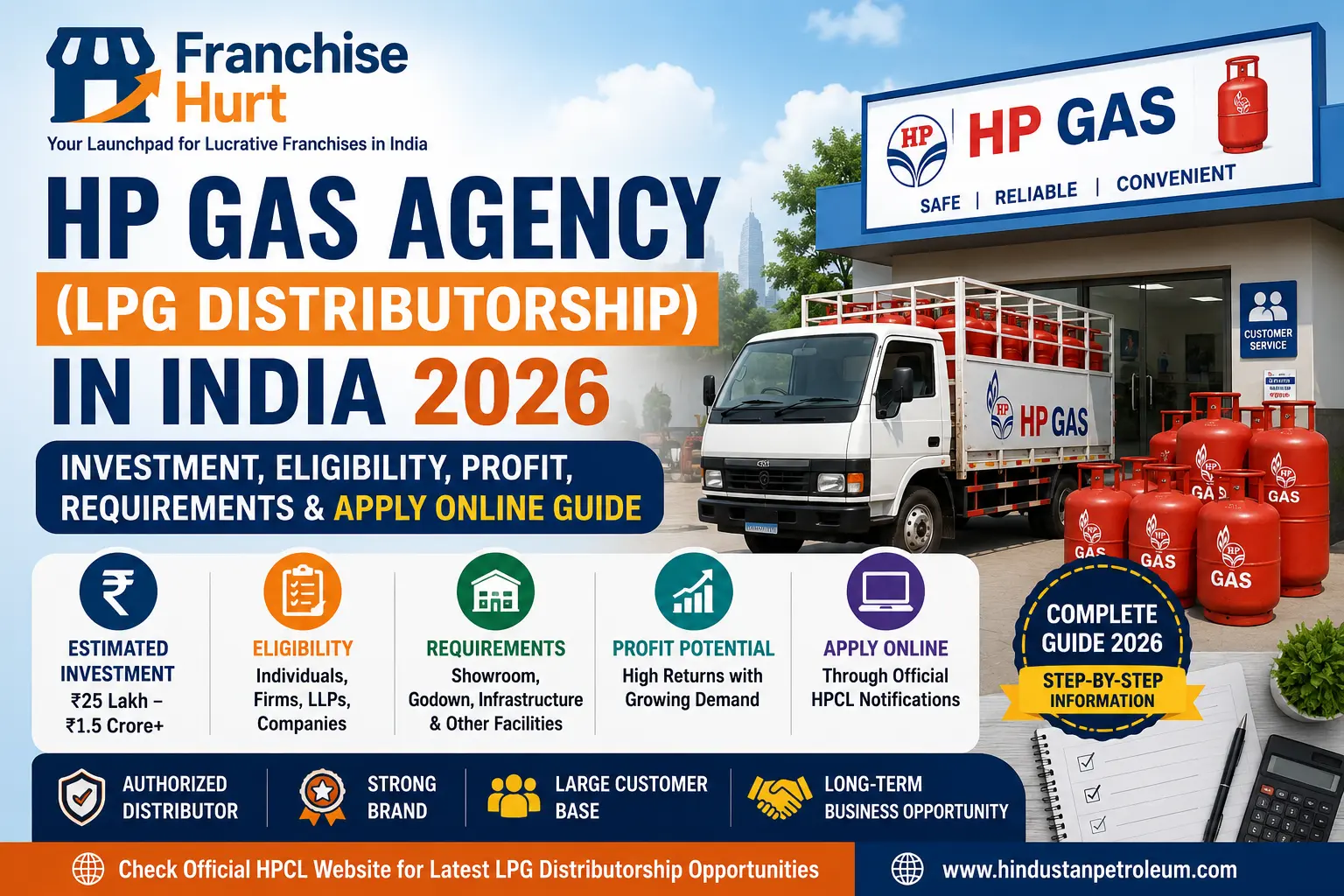
HP Gas Agency (LPG Distributorship) in India 2026: Investment, Eligibility, Profit, Requirements & Apply Online Guide
India’s LPG sector remains one of the most important components of the country’s energy ecosystem. Millions of households, restaurants, hotels, catering businesses, and commercial establishments depend on LPG cylinders every day. As demand for clean cooking fuel continues to grow, many entrepreneurs are exploring opportunities to become authorized LPG distributors.
Among India’s leading LPG brands, HP Gas has established a strong presence through its extensive distribution network and customer base. If you are considering starting an HP Gas Agency, it is important to understand that HPCL officially operates through an LPG Distributorship model rather than a traditional franchise system.
This comprehensive Franchise Hurt guide covers everything you need to know about HP Gas LPG Distributorship opportunities, including investment requirements, eligibility criteria, infrastructure needs, application process, revenue opportunities, risks, and future growth prospects.
HP Gas Agency (LPG Distributorship): Quick Overview
| Particulars | Details |
|---|---|
| Brand Name | HP Gas |
| Parent Company | Hindustan Petroleum Corporation Limited (HPCL) |
| Business Opportunity Type | LPG Distributorship |
| Commonly Known As | HP Gas Agency |
| Industry | Oil & Gas |
| Estimated Investment | ₹25 Lakh – ₹1.5 Crore+ |
| Showroom Requirement | 200–500 Sq. Ft. (Estimated) |
| LPG Godown Requirement | As per safety and regulatory norms |
| Revenue Sources | Domestic & Commercial LPG Distribution |
| Application Mode | Official HPCL Notifications |
| Territory Allocation | Company Specific |
| Suitable For | Entrepreneurs, Investors, Landowners |
| Business Model | Authorized LPG Distributor |
Table of Contents
About HP Gas
HP Gas is the LPG division of Hindustan Petroleum Corporation Limited (HPCL), one of India’s largest public sector energy companies. Through its distributor network, HP Gas supplies LPG cylinders to millions of customers across urban, semi-urban, and rural India.
The company has built a strong reputation for safety, reliability, and customer service, making HP Gas one of the most recognized LPG brands in the country.
HP Gas Agency vs LPG Distributorship
Many people search online for terms such as HP Gas Agency, HP Gas Franchise, or HP Gas Dealership. However, HPCL officially appoints LPG Distributors.
An HP Gas Distributor is responsible for:
- LPG cylinder storage
- Customer registrations
- Booking management
- Home delivery operations
- Commercial LPG supply
- Safety compliance
Therefore, while the opportunity is commonly referred to as an “HP Gas Agency,” the official business model is an LPG Distributorship.
Research Insights: Why LPG Distribution Remains a Strong Business Opportunity
India has witnessed significant growth in LPG adoption over the last decade. According to the Ministry of Petroleum and Natural Gas, government initiatives promoting cleaner cooking fuels have contributed to widespread LPG adoption across urban and rural households.
Industry data published by the Petroleum Planning & Analysis Cell (PPAC) indicates that LPG continues to play a major role in India’s household energy consumption.
Key factors supporting LPG demand include:
- Increasing urbanization
- Rising household formation
- Growth of restaurants and food businesses
- Expanding commercial kitchen operations
- Continued preference for cleaner cooking fuels
These factors continue to support long-term opportunities for LPG distributors operating in growing markets.
Also Read: Nayara Petrol Pump Dealership
Types of HP Gas Distributorships
Depending on market demand and territory allocation, HPCL may offer different distributorship formats.
Domestic LPG Distributorship
This category serves:
- Individual households
- Apartment communities
- Residential consumers
Commercial LPG Distributorship
Commercial distributors supply LPG cylinders to:
- Restaurants
- Hotels
- Catering businesses
- Food processing units
- Commercial kitchens
Combined Distribution Model
Certain distributors may serve both domestic and commercial customers depending on the territory and company requirements.
Why Choose HP Gas Instead of Starting an Independent LPG Business?
Starting an independent LPG business requires significant effort to build supply chains, establish brand recognition, and develop customer trust.
With HP Gas, distributors benefit from:
- Established national brand
- Existing market demand
- Operational guidelines
- Supply chain support
- Safety standards
- Customer confidence
These advantages can help reduce several challenges associated with building an LPG business from scratch.
Eligibility Criteria
Eligibility requirements may vary depending on distributorship advertisements and territory requirements.
Individual Applicants
Applicants generally should:
- Be Indian citizens
- Possess valid identity and address proof
- Demonstrate financial capability
- Meet conditions mentioned in official notifications
Business Applicants
Applications may be accepted from:
- Proprietorship firms
- Partnership firms
- LLPs
- Private Limited Companies
Applicants should always refer to the latest HPCL distributorship notification for specific eligibility conditions.
Infrastructure Requirements
Infrastructure readiness is one of the most important factors for distributorship approval.
Showroom Requirement
The distributor generally requires a customer service office or showroom.
Estimated requirement:
- Approximately 200–500 square feet or more
LPG Godown Requirement
Distributors typically require approved LPG storage facilities that comply with applicable safety regulations.
Requirements vary depending on:
- Storage capacity
- Territory size
- Regulatory norms
- Safety guidelines
Delivery Infrastructure
Additional requirements may include:
- Delivery vehicles
- Cylinder handling equipment
- Safety equipment
- Trained manpower
Estimated Investment Required
The total investment required depends on territory allocation, infrastructure needs, storage capacity, and operational scale.
Based on industry benchmarks and publicly available distributorship information, the following estimates provide a general understanding.
| Investment Component | Estimated Cost |
|---|---|
| Security Deposit | ₹2 Lakh – ₹10 Lakh |
| Showroom Setup | ₹2 Lakh – ₹10 Lakh |
| Godown Development | ₹10 Lakh – ₹50 Lakh |
| Delivery Vehicles | ₹5 Lakh – ₹20 Lakh |
| Office Infrastructure | ₹2 Lakh – ₹10 Lakh |
| Working Capital | ₹5 Lakh – ₹50 Lakh |
| Estimated Total Investment | ₹25 Lakh – ₹1.5 Crore+ |
Investment Disclaimer
The investment figures mentioned above are estimates compiled by Franchise Hurt using publicly available distributorship information, LPG industry benchmarks, infrastructure costs, and market research.
HPCL does not publicly publish a standard investment amount applicable to every distributorship location. Actual investment requirements may vary depending on territory allocation, storage capacity, infrastructure requirements, land ownership status, local regulations, and company policies.
Prospective applicants should verify all current requirements directly through official HPCL sources before making any financial commitment.
What Support Does HP Gas Provide?
Authorized distributors may receive support in the following areas:
- Brand recognition
- Product supply and logistics
- Distributor operating procedures
- Safety training and guidelines
- Customer management systems
- Technical support
- Operational guidance
Support provided may vary depending on company policies and distributorship agreements.
Documents Required
Applicants may generally need:
Personal Documents
- Aadhaar Card
- PAN Card
- Passport-size photographs
- Address proof
Property Documents
- Land ownership records
- Lease agreements (if applicable)
- Site plans
- Property tax records
Financial Documents
- Bank statements
- Income Tax Returns
- Net worth certificates
- Financial capability proofs
Additional documents may be requested during the verification process.
Where to Check HP Gas Distributorship Advertisements?
HPCL generally announces new LPG distributorship opportunities through official notifications based on market demand and territory expansion requirements.
Interested applicants should regularly monitor:
- HPCL Official Website
- HP Gas Official Portal
- Regional newspaper advertisements
- Business opportunity notifications
Franchise Hurt Tip
Before purchasing land or investing in infrastructure, wait for an official distributorship advertisement and carefully review the eligibility criteria, infrastructure requirements, and application process mentioned in the notification.
How to Apply for an HP Gas LPG Distributorship
Step 1: Monitor Official Notifications
Watch for new distributorship advertisements released by HPCL.
official Link: HP Gas
Step 2: Review Eligibility Requirements
Carefully review land, infrastructure, financial, and documentation requirements.
Step 3: Submit Application
Complete the application process according to the official notification.
Download Form
Step 4: Verification Process
The company may verify:
- Applicant eligibility
- Financial capability
- Infrastructure readiness
- Documentation
Step 5: Selection Process
Selection is conducted according to the procedure specified in the notification.
Step 6: Infrastructure Development
Selected applicants complete required infrastructure and compliance requirements.
Step 7: Final Approval
Operations begin after successful verification and approval.
Estimated Setup Timeline
The time required to start operations can vary depending on location and infrastructure readiness.
Typical timeline may range between:
- 3 to 12 months
Factors affecting timelines include:
- Documentation readiness
- Land availability
- Regulatory approvals
- Infrastructure development
- Company verification procedures
Also Read: BPL Medical Technologies Dealership
How Does an HP Gas Distributor Earn Revenue?
Revenue is generally generated through LPG cylinder distribution.
Domestic LPG Distribution
Revenue from serving residential customers.
Commercial LPG Distribution
Revenue from:
- Restaurants
- Hotels
- Caterers
- Commercial kitchens
Additional Revenue Opportunities
Some distributors may also generate income through:
- LPG accessories
- Safety products
- Commercial contracts
Actual profitability depends on customer base, sales volume, and operational efficiency.
Common Reasons Applications Get Rejected
Some common reasons include:
- Incomplete documentation
- Unsuitable land or infrastructure
- Financial capability concerns
- Property-related legal issues
- Failure to meet eligibility criteria
- Non-compliance with safety requirements
Proper preparation can significantly improve approval chances.
Advantages and Challenges
Advantages
- Strong brand recognition
- Essential product category
- Recurring customer demand
- Long-term business opportunity
- Established supply chain support
Challenges
- Infrastructure investment
- Safety compliance obligations
- Logistics management responsibilities
- Working capital requirements
- Territory-based limitations
Future Outlook
India’s LPG sector is expected to remain a key part of household and commercial energy consumption for years to come.
Continued urbanization, growth in food service businesses, increasing household formation, and ongoing demand for clean cooking fuel are expected to support LPG distribution networks.
At the same time, customer expectations continue evolving. Successful distributors are increasingly focusing on:
- Faster deliveries
- Digital booking systems
- Improved customer service
- Operational efficiency
- Enhanced safety standards
For entrepreneurs willing to invest in infrastructure and operations, an HP Gas LPG Distributorship can continue to offer long-term business opportunities within India’s growing energy market.
Conclusion
An HP Gas Agency, officially operated under the LPG Distributorship model, offers entrepreneurs an opportunity to participate in one of India’s most essential industries. Supported by strong brand recognition, established customer demand, and a growing LPG market, the business can provide long-term growth potential for qualified applicants.
However, success depends on proper planning, financial preparedness, infrastructure readiness, regulatory compliance, and operational excellence. Prospective applicants should verify all current requirements directly through official HPCL resources before making any investment decision.
Explore other Dealership Opportunities
Frequently Asked Questions (FAQs)
1. Is HP Gas Agency a dealership or distributorship?
Ans: HP Gas officially operates through an LPG Distributorship model, although many people commonly refer to it as an HP Gas Agency.
2. How much investment is required?
Ans: Estimated investment may range from ₹25 lakh to ₹1.5 crore or more depending on infrastructure and territory requirements.
3. Is land mandatory?
Ans: Yes. Suitable infrastructure, including a showroom and approved LPG storage facility, is generally required.
4. Can leased land be used?
Ans: Depending on the notification and company requirements, leased properties may be considered.
5. Does HPCL provide LPG cylinders?
Ans: Yes. LPG cylinders are supplied through the HP Gas distribution system.
6. Does HPCL provide delivery vehicles?
Ans: Generally, distributors arrange their own operational infrastructure, including delivery vehicles.
7. Is prior LPG business experience required?
Ans: Not necessarily, although business experience may be beneficial.
8. Can women apply?
Ans: Yes. Women may apply subject to eligibility conditions mentioned in official notifications.
9. Is profit guaranteed?
Ans: No. Profit depends on customer volume, sales, territory size, and operational efficiency.
10. Can companies apply?
Ans: Yes. Eligible business entities may apply subject to company guidelines.
11. How long does the approval process take?
Ans: The timeline varies depending on infrastructure readiness, documentation, and company procedures.
12. Is this a long-term business?
Ans: Yes. LPG distribution is generally considered a long-term business opportunity.
Follow Us on