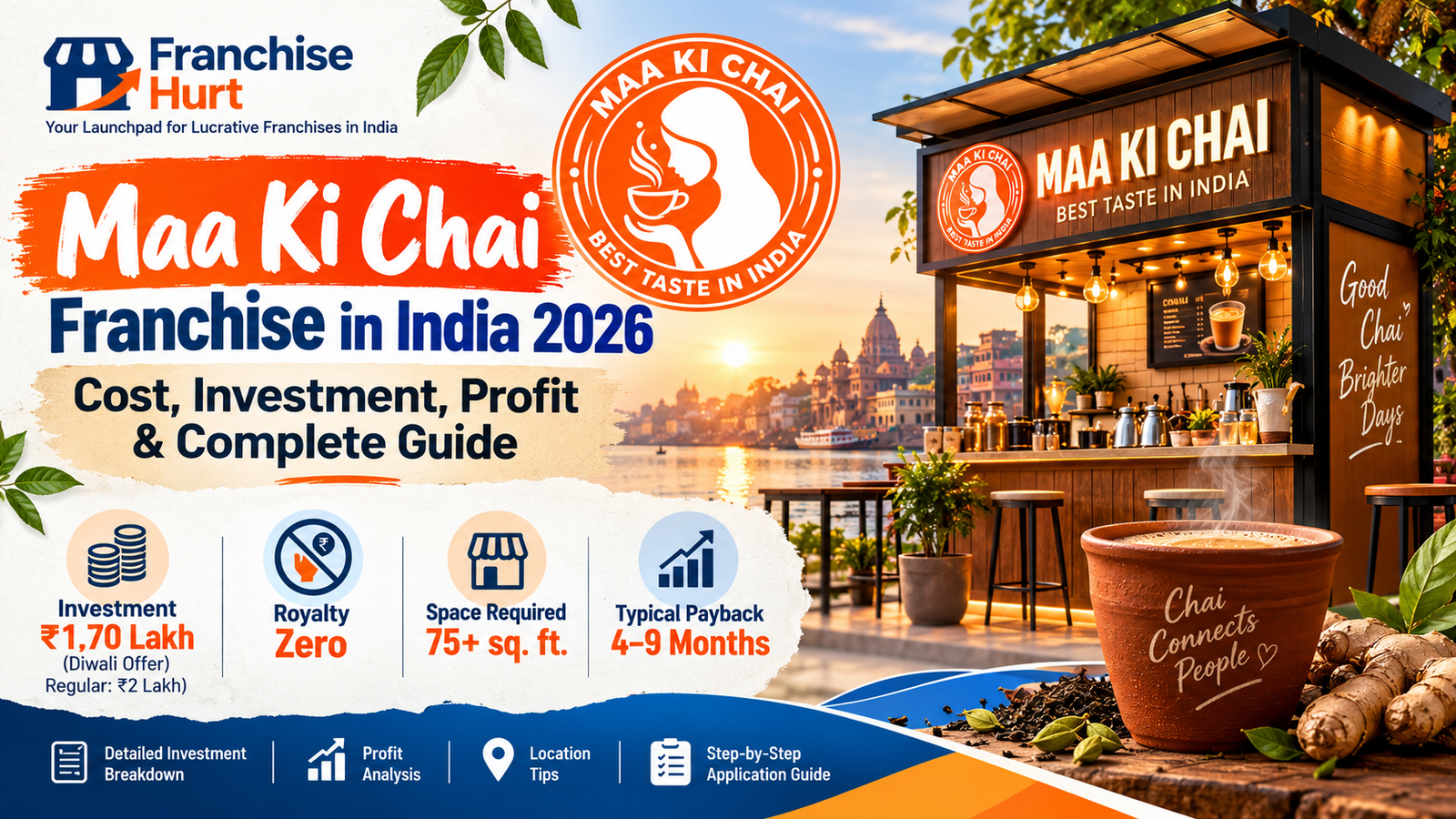
Maa Ki Chai Franchise in India 2026: Cost, Investment, Profit & Complete Guide
Starting a tea business can be an attractive option for entrepreneurs who want to enter India’s food-and-beverage market with a relatively compact outlet. But choosing a franchise requires more than comparing the initial fee. Investors must also understand the setup budget, rent, ingredient costs, customer demand, and time needed to recover their investment.
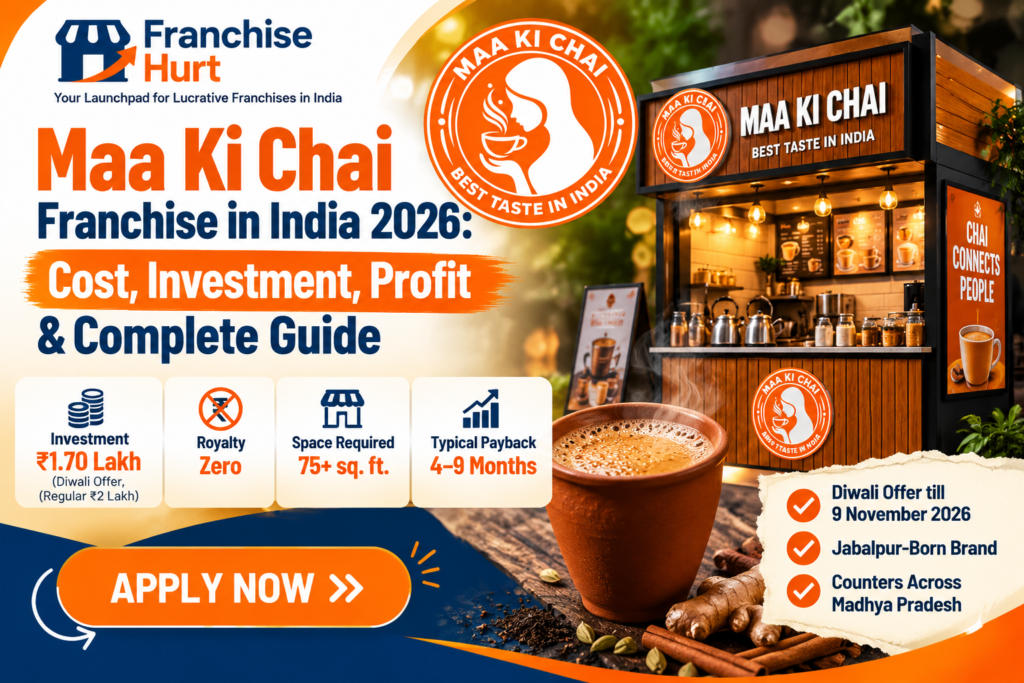
The Maa Ki Chai franchise in India is presented as a tea-kiosk opportunity operated by Algosphere Technologies LLP. According to the information supplied for this guide, the Standard Kiosk is priced at ₹1.70 lakh under a stated promotional offer, compared with a regular price of ₹2 lakh. A Growth Kiosk option is listed at ₹2.25 lakh.
The company information also describes the model as zero royalty, with no separate brand fee, and specifies a minimum space requirement of 75 square feet. A payback period of 4–9 months is mentioned for busy locations, although this should not be treated as a guaranteed result.
This guide explains the advertised franchise packages, the additional costs to budget for, a practical way to estimate profitability, and the questions to ask before signing an agreement.
Maa Ki Chai Franchise: Quick Overview 2026
| Particular | Details |
|---|---|
| Franchise brand | Maa Ki Chai |
| Business category | Food and beverage / tea kiosk |
| Company name | Algosphere Technologies LLP |
| Head office | Baner, Pune, according to the supplied details |
| Flagship café | Jabalpur, according to the supplied details |
| Standard Kiosk advertised price | ₹1,70,000 under the stated offer |
| Stated regular price | ₹2,00,000 |
| Growth Kiosk advertised price | ₹2,25,000 |
| Minimum space | 75 sq. ft. |
| Maximum space | Not specified in the supplied information |
| Royalty | Advertised as zero royalty |
| Separate brand fee | Stated as not applicable |
| Indicative payback claim | 4–9 months at busy locations; not guaranteed |
| Official franchise page | https://maakichai.com/chai-franchise/ |
| Contact email | support@maakichai.com |
The prices and terms above come from the information provided for this article. Confirm the current offer, taxes, package inclusions, and contractual conditions directly with Maa Ki Chai before investing.
Table of Contents
What Is Maa Ki Chai?
Maa Ki Chai is presented as a tea-kiosk franchise opportunity from Algosphere Technologies LLP. Its compact format may interest people who want to operate a tea outlet without immediately committing to a large café.
A tea kiosk can serve customers in office areas, residential neighbourhoods, shopping streets, educational zones, transport corridors, and other locations with regular demand for beverages. The commercial potential of each location, however, depends on the type of customers nearby, local competition, rent, pricing, and operating efficiency.
For a prospective franchisee, the key consideration is whether the brand’s proposed business model fits the local market. Before paying a fee, request the current menu, package details, training plan, equipment list, supply arrangements, and franchise agreement.
Maa Ki Chai Franchise Cost in India
The supplied information lists two kiosk options. These should be considered the advertised package prices—not automatically the complete cost of opening and operating the business.
1. Standard Kiosk: ₹1.70 Lakh
The Standard Kiosk is listed at ₹1.70 lakh under the stated offer, compared with a regular price of ₹2 lakh.
According to the supplied details, this amount is described as a one-time franchise fee. The company is also said to charge no separate brand fee and no royalty.
Before assuming that the package covers the entire setup, ask the company for an itemised list of inclusions. Confirm whether the kiosk structure, equipment, signage, utensils, initial stock, transportation, installation, and taxes are covered.
The amount required to start trading may be higher if the franchisee must separately pay rent, a security deposit, setup expenses, registrations, staff costs, and working capital.
Also Read: Cheese Corner Franchise
2. Growth Kiosk: ₹2.25 Lakh
The Growth Kiosk is listed at ₹2.25 lakh in the supplied information.
The exact differences between the Standard and Growth packages have not been established here. Request a written comparison before choosing between them. It should explain any differences in equipment, layout, service capacity, menu, branding, training, and support.
The more expensive package is worthwhile only if its additional features meet the needs of the location and support a reasonable business case.
Total Investment: How Much Money Should You Budget?
The most important distinction for a first-time investor is the difference between the franchise package price and the total opening budget.
A business may advertise a low entry price, but the owner still needs enough money to secure the premises, prepare the kiosk, purchase any items excluded from the package, and pay expenses while sales develop.
The following is an illustrative planning budget. These additional amounts are estimates for financial planning, not verified Maa Ki Chai charges or official company quotations.
Estimated Investment Breakdown
| Cost component | Illustrative budget |
|---|---|
| Standard Kiosk advertised price | ₹1,70,000 |
| Rental deposit and initial premises costs | ₹15,000–₹60,000 |
| Additional setup, electrical work or installation | ₹10,000–₹35,000 |
| Initial ingredients and packaging, if not included | ₹5,000–₹15,000 |
| Local registrations and compliance allowance | ₹3,000–₹10,000 |
| Launch marketing and opening promotions | ₹3,000–₹10,000 |
| Initial working-capital reserve | ₹25,000–₹60,000 |
| Illustrative total budget | ₹2,31,000–₹3,60,000 |
This example assumes that the ₹1.70 lakh package price is paid separately from the listed allowances. It does not establish what the company actually includes in the package. Some expenses may already be covered, while others could be higher depending on the city, rent, layout, taxes, and equipment requirements.
The working-capital reserve is money kept available to pay operating expenses. It is not a one-time fee paid to the franchisor.
Illustrative Budget for the Growth Kiosk
The same planning approach can be used for the Growth Kiosk.
| Cost component | Illustrative budget |
|---|---|
| Growth Kiosk advertised price | ₹2,25,000 |
| Rental deposit and initial premises costs | ₹15,000–₹60,000 |
| Additional setup, electrical work or installation | ₹10,000–₹35,000 |
| Initial ingredients and packaging, if not included | ₹5,000–₹15,000 |
| Local registrations and compliance allowance | ₹3,000–₹10,000 |
| Launch marketing and opening promotions | ₹3,000–₹10,000 |
| Initial working-capital reserve | ₹25,000–₹60,000 |
| Illustrative total budget | ₹2,86,000–₹4,15,000 |
These figures are planning examples rather than official estimates. They assume the listed expenses are additional to the package price. Obtain an itemised quotation from the franchisor and actual rental and setup quotes before using these totals to make an investment decision.
Costs to Confirm Before Paying
Ask the franchise team to confirm the following in writing:
- Whether the kiosk structure and branding are included
- Which machines, utensils, and other equipment are supplied
- Whether initial ingredients and packaging are included
- Whether transportation, installation, and applicable taxes are extra
- Whether any refundable deposit or other payment is required
- Whether there are marketing, software, renewal, or other recurring charges
- Whether the franchisee must buy ingredients from specified suppliers
- What training and launch assistance are included
A complete quotation will help prevent a situation where an investor pays the advertised fee but does not have enough money left to open and run the outlet.
Also Read: Sky Laban Franchise
Space Required for Maa Ki Chai
The supplied details state a minimum area of 75 square feet. No maximum area is specified.
A small footprint may help keep rental costs manageable, but the actual suitability of a site depends on the equipment layout, storage, preparation space, cleaning arrangements, customer access, and applicable local rules.
Before renting a property, check:
- Whether the site is visible and accessible to the target customers.
- Whether there is sufficient room for safe preparation and storage.
- Whether water, electricity, drainage, and waste-disposal arrangements are suitable.
- Whether the landlord permits the intended food-and-beverage use.
- Whether the proposed business can obtain the necessary registrations and permissions.
- Whether the rent is reasonable compared with the sales the location could realistically generate.
A small kiosk in a busy, relevant customer area may be a better investment than a larger outlet with high rent and inconsistent demand.
Monthly Operating Costs of a Tea Kiosk
After opening, the business must generate enough sales to pay its recurring expenses. These costs vary by location, opening hours, menu, staffing model, and the terms of the franchise agreement.
| Monthly expense | What to consider |
|---|---|
| Rent | Monthly premises rent and any maintenance charges |
| Ingredients | Tea, milk, sugar, spices, and other menu ingredients |
| Packaging | Cups, lids, napkins, takeaway bags, and related items |
| Staff | Wages, statutory employment costs where applicable, and training |
| Utilities | Electricity, water, and cooking or heating requirements |
| Cleaning and maintenance | Hygiene supplies, repairs, and equipment upkeep |
| Marketing | Local promotions, offers, signage, and customer acquisition |
| Other expenses | Payment charges, transport, wastage, and miscellaneous costs |
A zero-royalty structure may remove one recurring cost, but it does not eliminate the expenses required to operate the kiosk.
Ask the franchisor for an expected monthly operating statement from comparable outlets, including the assumptions used for sales, ingredient costs, and staffing.
How Does the Maa Ki Chai Franchise Make Money?
A tea kiosk generally earns revenue through the sale of beverages and any additional food items offered by the outlet. Profitability depends on transaction volume, average customer spending, product costs, operating expenses, and wastage.
Consider five important measures when assessing the business:
Daily sales volume: How many paid orders can the site realistically generate?
Average bill value: How much does a customer spend per transaction?
Cost of goods sold: How much is spent on ingredients and packaging for each sale?
Monthly fixed costs: How much must be paid even during a slow sales period?
Repeat business: Can the kiosk build a regular customer base among nearby residents, employees, students, or commuters?
The franchise company’s current menu prices and any available outlet-level sales information can help the investor estimate these figures. Avoid using sales targets from a busy outlet as the expected result for every location.
Maa Ki Chai Franchise Profit Calculation: An Illustrative Example
The following calculation is a hypothetical example to show how a tea kiosk’s finances can be evaluated. It is not a forecast of Maa Ki Chai’s actual sales, margins, or profit.
Suppose an outlet records ₹3,000 in sales per day and operates for 30 days in a month.
| Calculation | Illustrative amount |
|---|---|
| Daily sales | ₹3,000 |
| Monthly sales (₹3,000 × 30) | ₹90,000 |
| Ingredients and packaging (assumed 35% of sales) | ₹31,500 |
| Rent | ₹12,000 |
| Staff costs | ₹15,000 |
| Utilities, cleaning and maintenance | ₹4,000 |
| Local marketing and miscellaneous expenses | ₹5,000 |
| Illustrative monthly operating surplus | ₹22,500 |
In this example, the monthly operating surplus is ₹22,500 before any applicable taxes, financing costs, depreciation, owner compensation not already included, and other unlisted expenses. The actual result could be substantially different.
The assumed 35% product-cost ratio and expense figures are used only to demonstrate the calculation. They are not verified company data or a claim about typical tea-kiosk performance.
What If Sales Are Lower?
The same outlet may face difficulty if daily sales are materially below expectations while rent and staffing expenses remain largely unchanged.
For example, if sales fall, ingredient costs may decrease with volume, but rent, some wages, and other fixed expenses will continue. This is why a location-specific break-even estimate is more useful than a headline profit claim.
Before investing, prepare at least three scenarios:
- Conservative: Lower sales and slower customer growth.
- Expected: Sales based on a realistic site assessment and verifiable comparable-outlet information.
- Optimistic: Strong demand and efficient operations, without assuming exceptional results are typical.
If the business is viable only in the optimistic scenario, reconsider the location, cost structure, or investment.
Maa Ki Chai Franchise ROI and Payback Period
The supplied information mentions a payback period of 4–9 months at busy locations, while noting that quieter locations can take longer. This is an indicative claim that should be independently checked with the franchisor.
Payback period means the time required for cumulative cash generated by the business to recover the initial investment. It should be calculated using the complete opening investment—not just the advertised franchise fee.
For example, if an investor spends ₹3 lakh in total, the calculation must consider the actual cash remaining after ingredients, rent, wages, utilities, taxes, and other relevant expenses. A ₹3 lakh investment cannot be assumed to be recovered in a particular number of months without reliable operating data.
Ask the company:
- Are the 4–9-month figures based on actual outlets?
- Are they calculated using the complete investment or only the franchise fee?
- Do they account for rent, wages, wastage, taxes, and working capital?
- Are they based on average-performing outlets or only busy sites?
- Can the company share anonymised sales and expense figures from comparable locations?
Do not treat an advertised payback period as a promise of returns.
Turn Your Chai
Dream Into Business.
Explore the Maa Ki Chai kiosk opportunity and take a closer look at a compact format for entering India’s tea business.
Save ₹30,000 against the stated regular price.
Offer stated to run through 9 November 2026. Confirm availability with the brand.A small kiosk.
A local customer base.
Your business journey.
Zero royalty and payback claims are subject to the brand’s current terms. Actual results depend on location, costs, customer demand and business management. Verify package inclusions and the full setup budget before paying.
Is Maa Ki Chai a Zero-Royalty Franchise?
According to the supplied information, Maa Ki Chai advertises zero royalty and no separate brand fee. This may be beneficial for an owner because recurring royalty payments can reduce the cash retained by the outlet.
However, investors should check the signed agreement to confirm that no other recurring fees apply. A business can have zero royalty and still incur costs for ingredients, packaging, rent, staff, maintenance, marketing, technology, or renewals.
The agreement should clearly state the franchise fee, payment schedule, duration, renewal conditions, territory rights if applicable, supplier obligations, exit provisions, and refund terms.
Who Should Consider the Maa Ki Chai Franchise?
The opportunity may be worth evaluating for:
- First-time entrepreneurs exploring the tea and beverage category
- Individuals who can actively supervise a small food outlet
- Existing shop owners who want to assess an additional beverage offering
- Investors with access to a suitable, affordable commercial location
- Entrepreneurs who can maintain working capital after paying the initial fee
It may be less suitable for people expecting passive income without day-to-day oversight. Food businesses require attention to hygiene, service consistency, inventory, staff, and customer feedback.
An investor with a total budget of ₹1.70 lakh should be especially careful. That amount is the advertised Standard Kiosk price in the supplied details, not necessarily enough to cover every setup and operating expense.
How to Choose the Right Location
Location quality is one of the most important factors in a tea kiosk’s financial performance.
Understand the customer base. Identify nearby offices, colleges, residential areas, shopping streets, or transport points that could provide repeat demand.
Observe footfall. Visit at different times of day and on multiple days. Count relevant potential customers rather than relying on general pedestrian movement.
Study competitors. Compare nearby tea stalls and cafés on pricing, service speed, product range, cleanliness, and customer traffic.
Check rental affordability. Estimate how much sales revenue would be needed to cover rent and other fixed expenses.
Review accessibility. Consider visibility, safe customer access, stopping space, and convenience for takeaway orders.
Confirm permissions. Check the landlord’s approval and all relevant local requirements before committing to the property.
A lower-cost site is not automatically better if it attracts few customers. Likewise, a high-footfall location can still be unprofitable if its rent is too expensive.
How to Apply for a Maa Ki Chai Franchise
The official application page supplied for this article is:
Apply online: https://maakichai.com/chai-franchise/
Prospective franchisees can follow these steps:
- Visit the official franchise page and review the current packages.
- Submit the enquiry information requested by the company.
- Share your preferred city, available investment, and proposed location.
- Request the latest Standard and Growth Kiosk quotations.
- Ask for the package inclusions, recurring costs, franchise agreement, and training details.
- Check the proposed location and prepare a realistic financial projection.
- Verify any applicable licences, registrations, and property permissions.
- Proceed only after reviewing the documents and confirming the terms in writing.
Email: support@maakichai.com
Before making a payment, independently confirm that the website, payment beneficiary, and agreement correspond to the authorised business.
Ready to Start Your Chai Business?
Explore Maa Ki Chai franchise options, review the latest offer and confirm the investment details directly with the brand.
APPLY NOW ➜Official Maa Ki Chai franchise application page
Important Questions to Ask Before Investing
Use this checklist when speaking with the franchise team.
- Is the ₹1.70 lakh offer currently available, and when does it expire?
- What exactly is included in the Standard Kiosk package?
- What additional features does the ₹2.25 lakh Growth Kiosk provide?
- Are applicable taxes included in the quoted prices?
- Are the kiosk structure, equipment, signage, delivery, and installation included?
- Are there any deposits, renewal charges, marketing fees, or other recurring costs?
- What training and opening support are provided?
- Are ingredients purchased from approved suppliers?
- What are the actual sales and operating costs at comparable locations?
- How is the stated 4–9-month payback period calculated?
- What happens if the outlet underperforms or the agreement ends?
- Which local registrations and permissions must the franchisee obtain?
Written answers will make it easier to compare the opportunity with other tea franchises and independent kiosk models.
Final Verdict: Is Maa Ki Chai Worth Considering in 2026?
Maa Ki Chai is presented as a compact tea-kiosk franchise with a Standard Kiosk price of ₹1.70 lakh under the stated offer and a Growth Kiosk price of ₹2.25 lakh. The supplied details also advertise zero royalty and a minimum space requirement of 75 square feet.
These features may attract entrepreneurs seeking a small-format entry into the beverage sector. But the decision should not be based on the package price alone. Rent, setup costs, equipment, ingredients, staff, working capital, and location-specific demand can all influence the amount required and the time needed to recover it.
The most practical next step is to obtain the current written quotation, verify what each package includes, and request evidence behind the payback claim. Then compare the complete investment against conservative sales and expense assumptions for the proposed location.
For entrepreneurs who can supervise operations, select a suitable site, and retain sufficient working capital, Maa Ki Chai may be worth further investigation. Its suitability ultimately depends on verified commercial terms and the economics of the individual outlet—not a guaranteed return.
Frequently Asked Questions (FAQs)
1. What is the Maa Ki Chai franchise cost in India in 2026?
Ans: The supplied details list the Standard Kiosk at ₹1.70 lakh under a stated offer, against a regular price of ₹2 lakh. The Growth Kiosk is listed at ₹2.25 lakh. Confirm the current offer and package inclusions directly with the company.
2. Is ₹1.70 lakh enough to start the business?
Ans: Not necessarily. It is the advertised Standard Kiosk price in the supplied information. Rent deposits, additional equipment, setup work, stock, registrations, and working capital may increase the total budget.
3. How much space is required?
Ans: The supplied details state a minimum of 75 square feet. Confirm the approved layout and property requirements before signing a lease.
4. Does Maa Ki Chai charge royalty?
Ans: The supplied information describes the franchise as zero royalty with no separate brand fee. Check the agreement for other recurring payments and charges.
5. What is the expected ROI period?
Ans: The supplied information mentions 4–9 months at busy locations, with longer periods possible at quieter sites. This is not guaranteed. Ask for the calculation method and actual results from comparable outlets.
6. What are the monthly expenses?
Ans: Typical expense categories include rent, ingredients, packaging, staff, utilities, cleaning, maintenance, marketing, and miscellaneous operating costs. The exact amount depends on the location and business model.
7. How can I apply for the Maa Ki Chai franchise?
Ans: Visit https://maakichai.com/chai-franchise/ or email support@maakichai.com to request current franchise information.
8. Where is Maa Ki Chai’s head office?
Ans: The supplied details identify Baner, Pune, as the head-office location and Jabalpur as the location of the flagship café. Confirm current company information directly with the brand.
FranchiseHurt Investment Disclaimer
This article is intended for general informational and educational purposes. Franchise prices, promotional offers, package inclusions, and payback claims are based on the information supplied for this guide and have not been independently verified here. They may change without notice.
The additional investment budgets and financial examples are illustrative estimates for planning purposes only. They are not official Maa Ki Chai quotations, actual outlet results, or guarantees of profitability.
FranchiseHurt does not guarantee sales, profit, ROI, or recovery of investment. Actual outcomes depend on location, customer demand, operating expenses, management, contractual terms, and other factors. Readers should verify all information with the franchisor, review the franchise agreement carefully, and seek professional financial or legal advice where appropriate before investing.
Follow FranchiseHurt
Get franchise updates, business opportunities, dealership guides and practical insights to help you make informed investment decisions.
Last updated: October 2026