Smart Restaurant Automation in 2026: Boosting Franchise Productivity, Reducing Expenses, and Creating Exceptional Customer Experiences
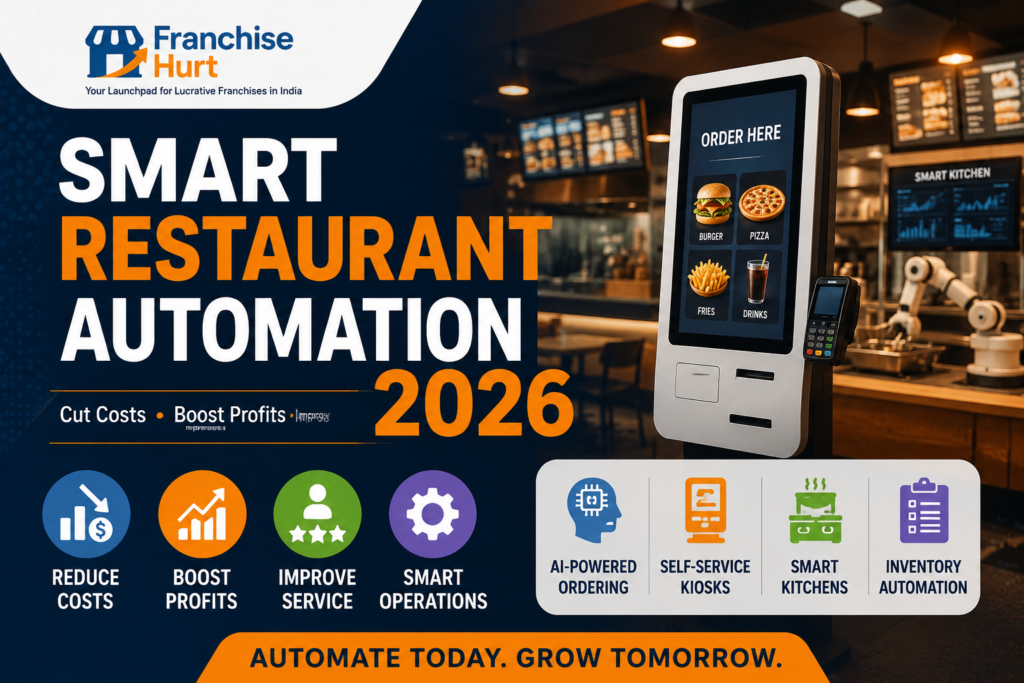
The restaurant industry is seeing a tremendous amount of change due to digitization. With the challenges of higher labor costs, changing consumer needs, and increased competition for franchise operators, automated technology has become a vital part of the way they do business and maintain their profits, as well as the way they operate uniformly.
Quick Overview Table – Smart Restaurant Automation
| Factor | Details |
|---|---|
| Industry | Restaurant & Food Service |
| Technology Focus | Restaurant Automation |
| Key Benefits | Higher Efficiency, Lower Costs, Better Customer Experience |
| Common Automation Tools | Self-Service Kiosks, AI Ordering, Smart Kitchen Equipment, Inventory Software |
| Cost Savings Areas | Labor, Food Waste, Order Errors, Administrative Tasks |
| Customer Benefits | Faster Service, Personalized Offers, Contactless Payments |
| Franchise Benefits | Standardized Operations, Easier Scaling, Better Reporting |
| Emerging Trends | AI Analytics, Robotics, Cloud-Based Management, Voice Ordering |
| Initial Investment | Moderate to High |
| ROI Timeline | Typically 6–24 Months |
| Best For | QSRs, Cafes, Cloud Kitchens, Multi-Location Restaurant Franchises |
Table of Contents
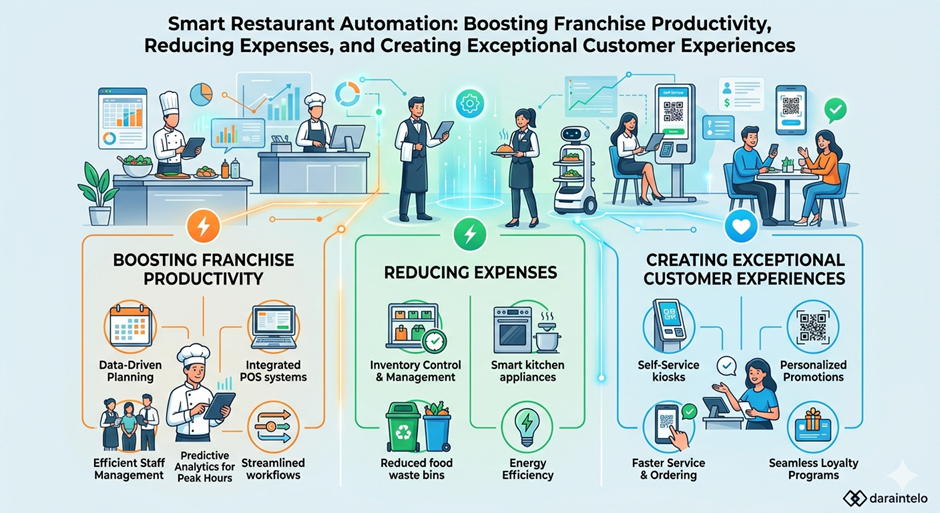
Restaurant automation is changing how franchise restaurants function. Automated systems such as self-serve kiosks, artificial intelligence driven ordering, automated inventory management systems, and smart kitchen appliances are helping restaurant owners to: Improve efficiencies throughout their businesses; help them lower their operational costs; increase customer satisfaction by providing superior service at all their locations.
According to DataIntelo, research shows that the Restaurant Automation Market will see continued growth worldwide, as restaurants now look at incorporating digital solutions to help boost operational efficiencies and ultimately improve operational performance.
Why Restaurant Automation Is Becoming Essential for Franchise Businesses
Restaurant automation is not just a means of doing business; it is a key factor in helping franchisors succeed with their franchises and providing the same level of service as that of independent restaurants. Franchisors face challenges that are different from those of independent restaurants and due to these challenges, or because they operate multiple restaurants, they must create greater standards of service, which cannot be accomplished without the use of automation technology.
Automation has become an integral part of all facets of the dining experience by:
- Minimizing the number of manual processes
- Reducing the incidence of errors
- Increasing levels of visibility across all aspects of the operation
- Increasing the productivity levels of employees
- Allowing for the ability to scale operations
As consumer demands continue to change the way businesses operate, automation is now an essential part of the business process, and must be incorporated into the strategic plans of all restaurants.
Transformation Through Automation Technologies in Your Restaurants
Today’s automation technologies are changing the structure of many aspects of restaurant automation, even those of your local restaurants.
Self Service Ordering
The most common form of restaurant automation is self-service ordering systems such as kiosks or mobile ordering apps. These types of systems provide customers with an easy to use and quick way to order food and drinks:
- Improve order accuracy.
- Increase average dollar amount per order due to auto upselling.
- Reduce front counter staff needed for taking orders.
Franchisees report efficiency gains and higher levels of customer satisfaction when they use digital ordering methods.
Kitchen Automation
Kitchen automation is another area where restaurants can reduce their labor costs and improve the quality of their food by using automation technology to make kitchen processes more accurate and efficient. Examples include:
- Automated cooking equipment
- Smart fryers
- Digital recipe management systems
- Temperature monitoring devices
- Automated food preparation tools
These technologies create a standard method for preparing food at the different franchise locations and minimize food preparation errors.
Automated Inventory Management
For restaurant operations, inventory management is very complicated. Some of the reasons for this complexity are the number of items a restaurant has, the variety of items, and how fast food is sold. When restaurants use automation to manage their inventory, they can do all of the following:
- Track their inventory in real time
- Predict how much food they will need to buy in the future
- Decrease the amount of food that gets thrown away, and
- Automate processes to reorder food when they are low on stock, so they never run out of stock.
Also, using automation increases the use of their resources and decreases their costs of doing business.
Also Read: Teaboy Franchise
AI-Powered Analytics
As an increasing number of restaurant operations implement Artificial Intelligence into their operations, AI-powered systems can determine what customers are going to purchase, how many of a particular item will be sold in the future, help manage staff by optimizing their schedules, and provide data that will help grow their businesses.
When restaurant franchise operators use data analytics to drive their decision-making process, they can see improvements in their profitability and productivity.
Improving Efficiency Across Franchise Networks
Operational efficiency is one of the main reasons that restaurant franchise operators are investing in automation. When a restaurant removes the time-consuming tasks that are done repetitively by their employees, they can improve the efficiency of the following tasks:
- Order processing
- Kitchen workflow
- Inventory control
- Reporting
- Staff schedules
These enhancements will allow the restaurant manager and each restaurant employee to dedicate themselves to providing great customer service and growing their respective businesses rather than performing administrative tasks at the restaurant.
Cutting Restaurant Operational Expenses with Automation
Operating cost control remains an area of emphasis for franchises.
Automation cuts operating costs in many ways such as:
Lower Labor Costs
Even though automation doesn’t completely take away human capital, it optimizes assigning your employees and lessens reliance on human-based activity by automating manual labor and processes.
Reduce the Waste of Food Products
Implementing an automated inventory tracking and forecasting system in your restaurant allows you to better order and reduce the supply of ingredients purchased for your business thus minimizing spoilage.
Improved Accuracy
There are many ways you can incur additional expense due to order inaccuracies or discrepancies between inventory and what was ordered, and human error in reporting. Automating this function greatly reduces the opportunity for you to incur these types of additional expenses.
Twice as Productive
By using automation, your employees will no longer have to spend time on daily administrative functions, allowing your employees to use their time to provide customers with exceptional value through their services.
Using Technology to Improve the Customer Experience
Over the last 10 years the behaviour of consumers has altered dramatically and consequently what customers expect from restaurants has also changed. Examples of customer expectations include:
- Faster Service
- Ability to Pay without Contact
- Ability to Order via Mobile Device
- Personalized Offers
- Consistent Experiences
Automating many of these processes and providing customers with access to additional services, such as digital loyalty programs can ultimately lead customers toward returning to dine at your restaurant on a repeat basis, thus helping to maintain and enhance your customer loyalty.
For franchise restaurants, improving your customers’ experience also translates into increased revenues and a higher-level brand.
Latest Developments In The Restaurant Industry That Are Increasing Automation Investment
There are a number of recent developments that have been rapidly driving the adoption of automation investment in the restaurant industry.
Utilizing Artificial Intelligence (AI) Technology
Restaurants are utilizing AI for everything from customer engagement to demand forecasting and improving their operating efficiencies.
Contactless Technology
The growing preference of customers for contact-free ordering and payment methods is on the rise.
Restaurant Management Systems Using Cloud Technology
Franchise owners can now track how they’re performing at multiple locations all through one central management system using the Cloud.
Customised Kitchen Technology (Kitchen Automations)
The use of kitchen automations and robotics (and other innovative kitchen technology) is becoming increasingly prevalent amongst chefs and operators who want to provide their customers with the highest quality of food and service possible.
Through the deployment of these technologies, operators can achieve greater flexibility and efficiency and improve their ability to serve their customers well.
Also Read: Domino’s Franchise
There are three primary drivers of growth in the restaurant automation marketplace
Several drivers of growth will continue to support the restaurant automation market as it matures and expands:
- Rising labour costs.
- Continued labour shortage.
- Increase in demand for convenience.
- Increasing digital adoption by consumers.
- Expansion of franchise operations in the restaurant sector.
- Advances in AI and Cloud technology.
- Needs for improved efficiencies.
These factors will continue to drive restaurant companies around the world to accelerate their digital transformation efforts.
Obstacles Franchise Owners ConsiderWhen Automating Restaurants Challenges To Consider When Implementing Automation
While there are many advantages of using automation in a restaurant, there are also many problems that can arise. Some factors that play a role in successful automation include:
1.Initial Capital Investment
Automation is an expensive decision to make, especially at the beginning stages.
2.Employee Training To Use New Technologies
Employees need thorough training in order to efficiently operate any type of equipment or system introduced into the business.
3.Integrating Different Systems
Integrating three or more different software programs and/or hardware systems into one seamless operation is very complex.
4.Need To Protect Customer’s Data
As restaurants gather data about their customers, data protection continues to be one of the biggest challenges in the restaurant industry.
Successful implementation of automation in the restaurant industry will take many months (and in some cases years) worth of planning and resources and will require employee participation.
Successful implementation of automation in the restaurant industry will take many months (and in some cases years) worth of planning and resources and will require employee participation.
At present, examples of some of the trends that are expected to impact the future of automation in restaurants are listed below:
- Predictive Analytics
- Voice-Activated Order Taking
- Artificial Intelligence Customer Personalization
- Advanced Robotics
- Smart Kitchen Environments
- Automated Drive-Thru
- Franchise Performance Monitoring in Real-Time
As these technologies continue to grow, restaurant franchises will have an ever increasing opportunity to offer greater efficiencies, improved customer relationships and increased profits.
Conclusion
Automation is creating a completely new way for franchise restaurant owners to operate their businesses. Whether it is through improved operational efficiency, lower costs or improved customer experiences, the use of technology will be one of the most important parts of modern restaurant management.
The growth of the Restaurant Automation Market will continue to shape the restaurant industry due to high industry growth rates, changing consumer expectations and advancing technology.
Explore Other Franchises Opportunities
Frequently Asked Questions (FAQs)
1. What is restaurant automation?
Ans: Restaurant automation refers to the use of technology, software, artificial intelligence (AI), and smart equipment to automate various restaurant operations such as ordering, payments, inventory management, kitchen workflows, and customer engagement. It helps improve efficiency while reducing manual effort.
2. How does automation help restaurant franchises?
Ans: Automation helps restaurant franchises maintain consistency across multiple locations, reduce operational errors, improve service speed, lower costs, and provide a standardized customer experience. It also makes franchise expansion easier and more manageable.
3. What are the most common restaurant automation technologies?
Ans: Some of the most widely used restaurant automation technologies include:
Self-service kiosks
Mobile ordering applications
AI-powered ordering systems
Smart kitchen equipment
Inventory management software
Contactless payment systems
Customer loyalty programs
4. Can automation reduce restaurant operating costs?
Ans: Yes. Restaurant automation can significantly lower operational expenses by reducing labor requirements, minimizing food waste, improving inventory accuracy, reducing order mistakes, and automating repetitive administrative tasks.
5. Is restaurant automation suitable for small restaurants?
Ans: Absolutely. Small restaurants can start with affordable solutions such as digital POS systems, QR-code menus, online ordering platforms, and inventory management software before investing in advanced automation technologies.
6. How does AI improve restaurant operations?
Ans: AI helps restaurants analyze customer behavior, forecast demand, optimize employee scheduling, personalize marketing campaigns, improve inventory planning, and make data-driven business decisions that increase profitability.
7. What challenges do restaurants face when implementing automation?
Ans: Common challenges include:
High initial investment costs
Employee training requirements
Integration of multiple systems
Data privacy and cybersecurity concerns
Resistance to technological change
Proper planning and staff training can help overcome these challenges.
8. Does automation replace restaurant employees?
Ans: No. Automation is designed to support employees rather than replace them. It handles repetitive and time-consuming tasks, allowing staff to focus on customer service, food quality, and business growth.
9. What are the latest trends in restaurant automation?
Ans: Current trends include:
AI-powered customer personalization
Voice-assisted ordering
Kitchen robotics
Contactless dining experiences
Cloud-based restaurant management systems
Predictive analytics for demand forecasting
10. Is restaurant automation worth the investment?
Ans: For most restaurant franchises, automation offers a strong return on investment by improving operational efficiency, reducing costs, increasing customer satisfaction, and supporting long-term business growth. The benefits often outweigh the initial implementation costs.
11. How does automated inventory management benefit restaurants?
Ans: Automated inventory systems track stock levels in real time, forecast demand, reduce food wastage, automate reordering processes, and help restaurant owners maintain optimal inventory levels while controlling costs.
12. What is the future of restaurant automation?
Ans: The future of restaurant automation includes advanced AI systems, fully integrated smart kitchens, robotic food preparation, automated drive-thrus, real-time franchise performance monitoring, and highly personalized customer experiences powered by data analytics. These innovations are expected to further improve efficiency and profitability across the restaurant industry.